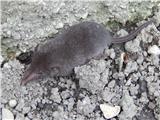
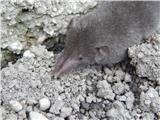
Lesser white-toothed shrew (Crocidura leucodon)
The lesser white-toothed shrew (Crocidura leucodon), also known in the professional literature as the bicolored white-toothed shrew, is a small mammal from the group of insectivores. Hikers often mistake it for a mouse due to its pointed snout, but it is an entirely different group of animals. Its most recognizable feature is the long, flexible, and extremely sensitive proboscis covered with numerous sensory hairs. It is distinguished from mice by its much smaller eyes and shorter tail, and from moles by its legs, which are not shovel-like but adapted for fast running.
Its habitat consists primarily of dry mountain meadows, shrublands, rocky fissures, and forest edges, where it is found up to the submontane zone. Shrews are extremely active animals with a very fast metabolism, so they must consume almost as much food daily as they weigh themselves. They feed mainly on insects, earthworms, spiders, and snails, which they tirelessly search for in leaf litter or among stones.
In Slovenia, it is widely distributed, but due to its secretive nature and lightning-fast movement, it is rarely observed calmly in the open. For hikers, an encounter with it represents an interesting diversion on the trail, as these tiny animals play a key role in the natural regulation of insect numbers in mountain ecosystems. In severe cold or lack of food, they can fall into a state of short-term torpor, thereby effectively conserving energy.
Images: