 | Aedes albopictus
Tiger mosquito (Aedes albopictus) first appeared in Slovenia in 2005, and today it is already an established species. Tiger mosquito grows up to 1 cm, usually they are somewhat smaller.... |
 | Aesculapian snake (Zamenis longissimus)
The Aesculapian snake with the scientific name Zamenis longissimus is our longest snake, often exceeding one and a half meters in length, and more rarely even two meters. Although its size surprises m... |
 | Aglais urticae
The Small Tortoiseshell is one of our most common and most recognizable diurnal butterflies from the Nymphalidae family. It is recognized by its vibrant orange-red wings with black spots and a charact... |
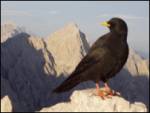 | Alpine Chough (Pyrrhocorax graculus)
Alpine Chough is an alpine bird which is very frequent in Slovenia. We can notice it on every top of the mountain above 1500 metres high above sea level. They are very friendly to mountaineers and are... |
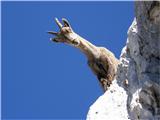 | Alpine Ibex (Capra ibex)
Rock goat is an alpine animal which lives on rocky regions, mostly above forest edge. Even above 3000 metres height above sea level. It descents a little bit lower in winter time because a lack of foo... |
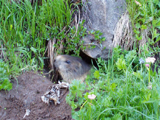 | Alpine Marmot (Marmota marmota)
Marmot is ranged as a rodent and weighs about 8kg. It has big eyes, small ears , long claws and short tail. It lives in communities of 10 members per family (pack). It eats plants (1kg per day). Young... |
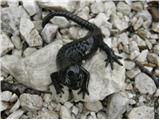 | Alpine Salamander (Salamandra atra)
Alpine Salamander which is recognized by its completely black color is in Slovenia the only amphibious animal which does not need water for survival. Preety large damp can satisfy its needs. It is mos... |
 | Anas platyrhynchos
The Mallard with the scientific name Anas platyrhynchos is our most widespread water bird, which hikers encounter along almost every mountain stream, river, or lake. The species is marked by pronounce... |
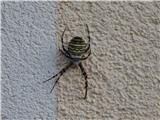 | Argiope bruennichi
Wasp spider (Argiope bruennichi), also known as wasp spider, is a spider species from the orb-weaver family. The spider, which got its name from the striped pattern, is found in Europe and North Afric... |
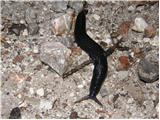 | Arion spp.
Slug is black colored and is 2cm thick and 15cm long. It crawls slowly and doesn't have a house. It is mostly seen during and after the rain in forests, meadows and by the water in region from lowland... |
 | Barn Swallow (Hirundo rustica)
The Barn Swallow (Hirundo rustica) is one of our most popular migratory birds, which hikers often encounter near mountain pastures, farms, and alpine huts below the forest line. Its appearance is unmi... |
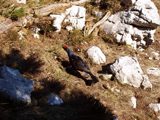 | Black Grouse (Lyrurus tetrix)
Black Grouse which belongs to family of forest hens lives in bright forests in high mountain range and in range of dwarf pine. It grows to about 50cm, female little less. It eats strawberry bushes, in... |
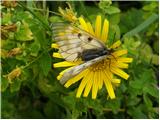 | Black-veined White (Aporia crataegi)
The Black-veined White is one of our larger and most recognizable whites, which we often encounter in early summer on flowering mountain meadows and along forest edges. Its wings are snow-white with d... |
 | Blindworm (Anguis fragilis)
The blindworm is a legless lizard up to 50 cm long, which is observed on sunny moist clearings, forest slopes and meadows up to an altitude of 2000 m. It is recognized by its gray-brown color, smooth ... |
 | Bos taurus
Cow is domesticated cattle. In Slovenian mountains and neighbour Alps we can notice them on mountain pastures in summer season when herdsmen drive them up to a mountain pasture. Male is called a bull ... |
 | Bristly cylinder fly (Cylindromyia interrupta)
The Bristly cylinder fly (Cylindromyia interrupta) is one of those unusual insects that hikers often notice on flowers along sunny mountain paths. From afar, it may remind us of a small wasp with its ... |
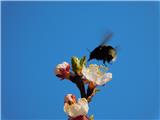 | Buff-tailed bumblebee (Bombus terrestris)
The buff-tailed bumblebee (Bombus terrestris) is one of those tireless pollinators that hikers encounter already on the first warmer spring days, when nature in the mountains is just awakening. We can... |
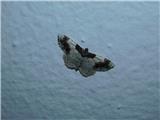 | Burnt trdoleskar (Ligdia adustata)
The burnt trdoleskar is a smaller and very recognizable nocturnal butterfly or moth from the family of geometrids, which is often observed during hiking in the lowlands and hills at forest edges, on c... |
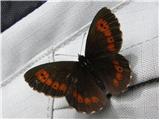 | Butterfly (Lepidoptera)
Butterflies are flying insects covered with tiny scales. It is precisely because of the scales that butterflies, of which we know more than 150,000 species, differ from other insects. Butterflies are... |
 | Cantans bush-cricket (Tettigonia cantans)
The Cantans bush-cricket (Tettigonia cantans) is a powerful insect from the bush-cricket family, which hikers often see or at least hear on high-alpine meadows, clearings, and in bushes. It differs fr... |
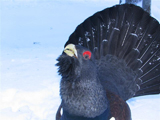 | Capercaillie (Tetrao urogallus)
Big or wild capercaillie is the bigest forest hen. It is mostly seen in peaceful large forests above 800 metres height above sea level. Male weighs about 5kg while female weighs about 3kg. It eats nee... |
 | Carniolan honey bee (Apis mellifera carnica)
The Carniolan honey bee (Apis mellifera carnica), which in our regions we respectfully and affectionately call the Carniolan grayling, is one of those animals that hikers most often encounter on flowe... |
 | Certhia familiaris
The Eurasian Treecreeper is a small, inconspicuous songbird that is perfectly adapted to life on tree trunks with its brown marbled back coloration. Its belly is snowy white, and its bill is thin and ... |
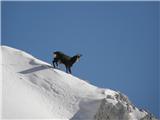 | Chamois (Rupicapra rupicapra)
Chamois belongs to family of hollow horns. It grows to about 100 cm, usually to 80cm. It weighs about 30kg. It is recognized by its small and hooked horns and usually by its white beard. It lives just... |
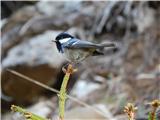 | Coal Tit (Parus ater)
Coal Tit (Parus ater) is a bird that belongs to the tit family.... |
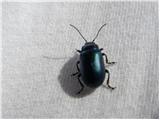 | Coleoptera
The alder leaf beetle with the scientific name Agelastica alni is a small but very noticeable beetle due to its characteristic color, which hikers most often encounter near water. Its oval and strongl... |
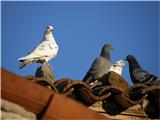 | Columba livia domestica
The domestic pigeon is a bird observed in almost all alpine and non-alpine cities. In some cities, however, the domestic pigeon causes many problems. It is also known by the name flying rat as it carr... |
 | Common Blackbird (Turdus merula)
The Common Blackbird (Turdus merula) is one of our most widespread and recognizable songbirds, which hikers encounter from lowland gardens to high mountain forests below the treeline. Adult males are ... |
 | Common Buzzard (Buteo buteo)
The Common Buzzard (Buteo buteo) is our most common bird of prey, which hikers often notice perched motionless watching for prey along forest edges or soaring high above hilly meadows. Its feather col... |
 | Common Crane (Grus grus)
The Common Crane (Grus grus) is regarded as one of the most powerful migrants, which hikers in Slovenia most frequently observe during spring and autumn migration, when in large flocks it flies over o... |
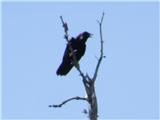 | Common Raven (Corvus corax)
Common raven is an alpine bird which belongs into family of crows. About 60cm tall bird lives in a region from forest edge till 3000 metres height above sea level and more. It descents a little bit lo... |
 | Common Starling (Sturnus vulgaris)
The Common Starling (Sturnus vulgaris) is one of our most common and most adaptable birds, which hikers often spot on pastures, at forest edges, and near mountain farms. Young specimens, like the one ... |
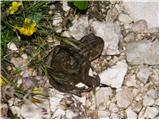 | Common Toad (Bufo bufo)
Usual toad which lives on land (meadows, forests and fields) grows up to 13cm, males a little less. Toad lives in water only as a tadpole and in time when it lays of eggs. Eggs are attached to strips ... |
 | Common wall lizard (Podarcis muralis)
The common wall lizard with the scientific name Podarcis muralis is probably the most faithful companion of hikers, as it is often encountered along alpine trails, on rocky outcrops, and even on the w... |
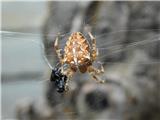 | Cross spider (Araneus diadematus)
Cross spider (Araneus diadematus) is a spider from the orb-weaver family (Araneidae).... |
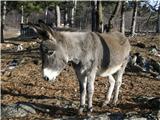 | Donkey (Equus africanus asinus)
The donkey (Equus africanus asinus) is a land animal from the horse family (Equidae).... |
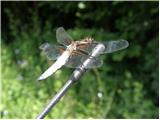 | Dragonflies (Odonata)
Dragonfly is a flying insect up to 10 cm in size found almost all over the world. It is most often observed near rivers, streams, swamps and lakes from lowlands to mid-mountains. Younger dragonflies ... |
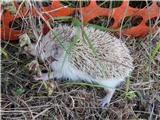 | Erinaceus concolor
The white-breasted hedgehog (Erinaceus concolor) is 1 of 15 species of hedgehogs that live on Earth, of which only 2 in Europe. The white-breasted hedgehog, also eastern European hedgehog, diffe... |
 | Eurasian Collared Dove (Streptopelia decaocto)
The Eurasian Collared Dove (Streptopelia decaocto) is one of our most popular and widespread species from the pigeon family, which hikers often encounter in mountain villages and near human settlement... |
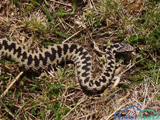 | European adder (Vipera berus)
Viper is the most extended snake species in Slovenian and European mountains. It is mostly seen on damp and hot days on clearings, forest edges, dwarf pines and mountain paths on start of alpine seaso... |
 | European green woodpecker
The European green woodpecker (Picus viridis) is a bird that belongs to the woodpecker family.... |
 | European hare (Lepus europaeus)
European hare (Lepus europaeus).... |
 | European Hornet (Vespa crabro)
In the mountain ecosystem, the European Hornet (Vespa crabro) plays an exceptionally beneficial role as a natural regulator, preying on beetles, flies, and various pests. Its presence in nature is act... |
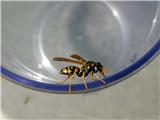 | European paper wasp (Polistes dominula)
The European paper wasp (Polistes dominula) is one of the most common insects noticed by hikers on sunny mountain paths or near the walls of mountain huts. It differs from the common wasp mainly by it... |
 | European Robin (Erithacus rubecula)
The European Robin (Erithacus rubecula) is one of those birds that hikers in the mountains most often encounter up close, as it is naturally very curious and often unafraid of humans. Its most recogni... |
 | Euscorpius gamma
The Slovenian scorpion (Euscorpius gamma) grows to around 3 cm in length and has mild venom and is not aggressive, therefore mostly not dangerous to humans.... |
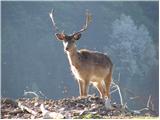 | Fallow Deer (Dama dama)
Fallow deer is a species of eers which is domesticated in some places. It belongs to medium high deers. Female fallow deer is a hind (just like at ordinary deer). It is about 100cm tall, if we count i... |
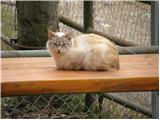 | Felis silvestris catus
The domestic cat (Felis silvestris catus) is a domestic animal that lives in alpine and non-alpine countries. On farms they keep it mainly to catch mice, in cities they breed it as a pet. There a... |
 | Field cricket (Gryllus campestris)
The field cricket (Gryllus campestris) is one of the most recognizable insects of our sunny and dry meadows, creating a characteristic soundscape of the warmer months with its tireless chirping. It is... |
 | Forest Pantherlet (Abraxas sylvata)
Forest Pantherlet (Abraxas sylvata) is a species of butterfly.... |
 | Formicidae
Formicidae are terrestrial animals that are widespread all over the world.... |
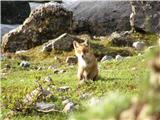 | Fox (Vulpes vulpes)
The red fox (Vulpes vulpes) is one of the most adaptable and intelligent animal species, inhabiting almost all ecosystems from lowland forests to high alpine screes. It is recognized by its slender b... |
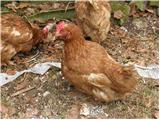 | Gallus gallus domesticus
The domestic chicken (Gallus gallus domesticus) is an animal that is believed to have been domesticated as early as the 6th millennium BCE. The male of the domestic chicken is a rooster, the female a ... |
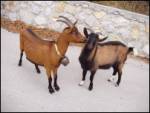 | Goat (Capra aegagrus hircus)
The goat is a domesticated animal that belongs to the family of bovids. During the summer period goats are often observed on mountain pastures in a large part of the Alps.... |
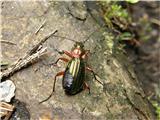 | Golden ground beetle (Carabus auronitens)
The golden ground beetle with the scientific name Carabus auronitens is a true jewel of our mountain forests, as its metallic sheen immediately catches the attention of every hiker. Its elytra are shi... |
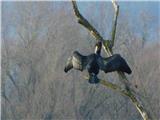 | Great Cormorant (Phalacrocorax carbo)
Great Cormorant (Phalacrocorax carbo) is a large bird, whose wingspan can approach 200 cm.... |
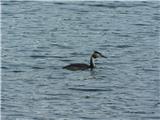 | Great crested grebe (Podiceps cristatus)
Great crested grebe (Podiceps cristatus) is a water bird up to about half a meter long that belongs to the grebe family.... |
 | Great green bush-cricket (Tettigonia viridissima)
The great green bush-cricket (Tettigonia viridissima) is one of the largest and most interesting inhabitants of our mountain meadows and shrubbery. Although it is often mistakenly called a grasshopper... |
 | Great Spotted Woodpecker (Dendrocopos major)
The Great Spotted Woodpecker (Dendrocopos major) is our most common and most recognizable species of woodpecker, which hikers in the hills often spot climbing tree trunks or hear its characteristic dr... |
 | Great White Egret (Egretta alba)
Great White Egret (Egretta alba) is up to about 100 cm tall bird from the heron family.... |
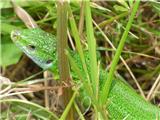 | Green lizard (Lacerta viridis)
The common green lizard with the scientific name Lacerta viridis is one of our most beautiful and powerful lizards, which with its intense emerald color immediately catches the eye of every hiker. Adu... |
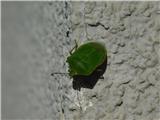 | Green shield bug (Nezara viridula)
Green shield bug (Nezara viridula) is an insect from the family of shield bugs.... |
 | Grey Heron (Ardea cinerea)
The Grey Heron (Ardea cinerea) is a powerful and elegant bird that hikers often spot standing motionless in shallow water or on bank rocks, lying in wait for prey. We recognize it by the ashen grey co... |
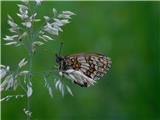 | Heath fritillary (Melitaea athalia)
Heath fritillary (scientific name Melitaea athalia)... |
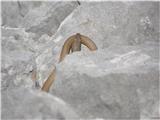 | Hierophis gemonensis
Belica (Hierophis gemonensis) is a rare, harmless, and extremely fast snake from the colubrid family that inhabits dry, sunny, and rocky areas of the Primorska region in Slovenia. Adult specimens are ... |
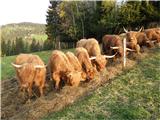 | Highland Cattle (Hairy Coo)
Highland Cattle is similar to domestic cattle only that it has longer coat and differently curved horns. Adult male bull weighs up to 900, female cow up to 600kg. Highland Cattle is extremely adaptabl... |
 | Horse (Equus caballus)
The horse is a domestic stable animal, often observed also in the alpine world on high pastures. Horses were formerly used for harnessing carts, today various competitions are held with them. ... |
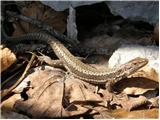 | Horvath's Rock Lizard (Iberolacerta horvathi)
Horvath's Rock Lizard is mostly seen in rocks, rocky walls and heap of stones on mountanious parts of Slovenia. It prefers regions shined by sun where it likes to expose to the sun.... |
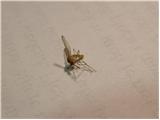 | House mosquito (Culex pipiens Linnaeus)
The common house mosquito is one of the most widespread and generally known insects that hikers often encounter near mountain huts, in valleys, and near stagnant water sources. It is recognized by its... |
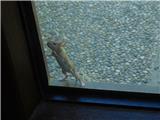 | House Mouse (Mus musculus)
The House Mouse (Mus musculus) is one of the most common small mammals that over millennia has closely attached itself to human proximity and dwellings. It is recognized by its slender body with grey-... |
 | House sparrow (Passer domesticus)
The house sparrow (Passer domesticus) is one of our best-known and most widespread birds, which hikers often encounter near alpine huts and in mountain settlements. Although it appears modest, it is a... |
 | Italian grasshopper (Calliptamus italicus)
In the mountain environment, where nature skillfully exploits every corner for living, hikers often notice the Italian grasshopper (Calliptamus italicus). This is a robust-bodied grasshopper whose gra... |
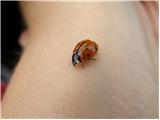 | Ladybird (Anatis ocellata)
Ladybirds which belongs to polynomials is up to 8mm long animal. It has black head, feet and breast. Her back is red or orange-red with some black dots. It can walk and fly. It eats leaves and lives o... |
 | Large pine weevil (Hylobius abietis Linnaeus)
Large pine weevil (Hylobius abietis Linnaeus) is one of the most recognizable beetles in our coniferous forests, which hikers often encounter on fresh clearings, stumps, or trunks of felled spruces an... |
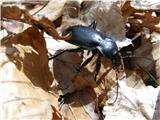 | Leathery carabid (Carabus coriaceus)
The leathery carabid with the scientific name Carabus coriaceus is a true giant among our beetles, as it can grow up to four centimeters in length. Due to its size and imposing appearance, it is hard ... |
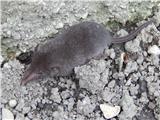 | Lesser white-toothed shrew (Crocidura leucodon)
The lesser white-toothed shrew (Crocidura leucodon), also known in the professional literature as the bicolored white-toothed shrew, is a small mammal from the group of insectivores. Hikers often mist... |
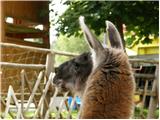 | Llama (Lama glama)
The llama is a domesticated member of the camel family originating from the high-altitude plateaus of South America. It is recognized by its long neck, slender legs, and characteristic banana-shaped e... |
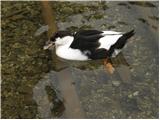 | Magpie duck (Anas platyrhynchos domestica)
The Magpie duck with the scientific name Anas platyrhynchos domestica immediately catches the eye with its contrasting black-and-white plumage and is considered one of the most colorful and interestin... |
 | Meadow Brown (Maniola jurtina)
The Meadow Brown (Maniola jurtina) is one of those butterflies that hikers most frequently notice on flowering mountain meadows, along forest edges, and in clearings. Its wings are adorned with a reco... |
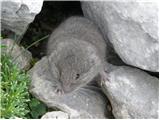 | Microtus nivalis
Microtus nivalis is a true symbol of survival in the demanding conditions of the high mountains, where hikers most often encounter it among scree slopes, in talus fields, or near mountain huts above t... |
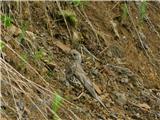 | Mistle Thrush (Turdus viscivorus)
Mistle Thrush (Turdus viscivorus) is a bird from the order of passerines and belongs to the thrush family.... |
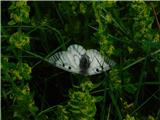 | Mnemosyne (Parnassius mnemosyne)
Mnemosyne (Parnassius mnemosyne) is a butterfly that belongs to the swallowtail family.... |
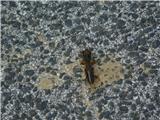 | Mole cricket (Gryllotalpa gryllotalpa)
Mole cricket (Gryllotalpa gryllotalpa) is an up to about 5 cm large insect that often lives in fields and gardens.... |
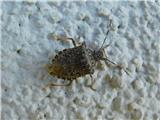 | Mottled shieldbug (Rhaphigaster nebulosa)
Mottled shieldbug (Rhaphigaster nebulosa) is a shield bug that grows to about 15 mm in length.... |
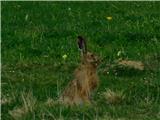 | Mountain hare (Lepus timidus)
Mountain hare (Lepus timidus).... |
 | Musca domestica
House fly (Musca domestica).... |
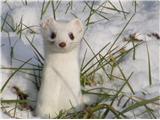 | Mustela erminea
The stoat or ermine is an animal up to 30cm in size, observed in areas rich in cover. It is recognized by its white-brown color with a black tail tip. In winter it is entirely white, except for the ta... |
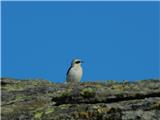 | Northern Wheatear (Oenanthe oenanthe)
The Northern Wheatear (Oenanthe oenanthe) is a slender and lively songbird, approximately the size of a sparrow, measuring between 14 and 16 centimetres. It is easiest to recognise by its characterist... |
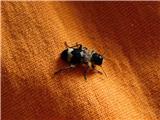 | Oak checkered beetle (Clerus mutillarius)
Oak checkered beetle (Clerus mutillarius) is an insect from the order of beetles.... |
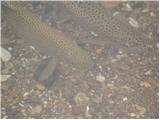 | Oncorhynchus mykiss
Rainbow trout (Oncorhynchus mykiss) is a trout species introduced from North America to Europe at the end of the 19th century. Today, rainbow trout is a widely distributed fish species in European wat... |
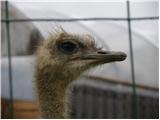 | Ostrich (Struthio camelus)
The African ostrich with the scientific name Struthio camelus is the largest bird in the world. Although its native habitat is far away, it is increasingly encountered on mountain farms and pastures t... |
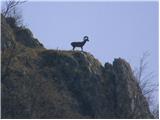 | Ovis musimon
The mouflon is a wild sheep that preferably inhabits dry, rocky, and hilly areas with light deciduous or mixed forests. In Slovenia, the mouflon is not a native species; it was first introduced in 195... |
 | Parus major
Great tit is about 14 cm large bird, which weighs around 20 g, wingspan is between 20 and 25 cm.... |
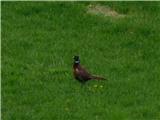 | Pheasant (Phasianus colchicus)
The pheasant is considered one of the most recognizable birds of our fields and forest edges. Hikers often spot it at the foot of hills or on sunny slopes, where it likes to linger in low shrubbery. A... |
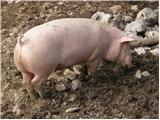 | Pig (Sus scrofa domestica)
Pig, hog or sow are three names for the same species of animal. Pig is a domesticated animal raised all over the world, and in summer it is often seen on alpine pastures. Well-known pork is produced f... |
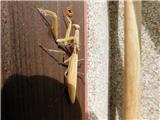 | Praying mantis (Mantis religiosa)
Praying mantis (Mantis religiosa)... |
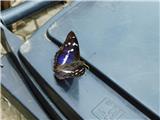 | Purple Emperor (Apatura iris)
Purple Emperor (Apatura iris).... |
 | Pyrrhula pyrrhula
The bullfinch grows to around 16 cm, weighs approximately 30 g, and has a wingspan of usually around 28 cm.... |
 | Radiated Wolf Spider (Hogna radiata)
The Radiated Wolf Spider (Hogna radiata) is one of the largest and most noticeable spiders that hikers encounter on sunny mountain paths or along the stone walls of huts. Although its name may sound e... |
 | Red admiral
Red admiral (Vanessa atalanta) is one of the most common butterflies in our region, belongs to the family of brush-footed butterflies.... |
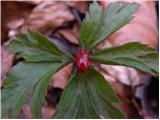 | Rhysodes sulcatus
The brazdar beetle is a smaller predatory beetle that lives mainly under the bark of dead trees. ... |
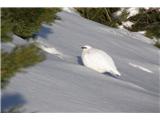 | Rock ptarmigan (Lagopus mutus)
Rock ptarmigan which grows to 30-40cm belongs to family of forest hens. We can notice it on rocky slopes 1300 till aproximately 4000 metres height above sea level. It is hardly noticeable because of i... |
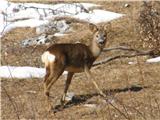 | Roe (Capreolus capreolus)
Roe (Capreolus capreolus) is our most common and most widespread species of game, which hikers in the mountain world often encounter on clearings, along the edges of forests, and on mountain meadows u... |
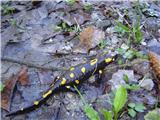 | Salamandra salamandra
The fire salamander is often observed on rainy days or immediately after rain, when the forest is still quite moist in bright deciduous and mixed forests. It is active mainly at night and in twilight... |
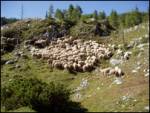 | Sheep (Ovis aries)
Sheep is a domestic animal often seen on mountain pastures, sometimes it stays even on peaks above 2500m. Sheep are shorn every year and high-quality wool is produced from their fleece. ... |
 | Smooth snake (Coronella austriaca)
The smooth snake with the scientific name Coronella austriaca is one of our most common yet most overlooked snakes. It is a small and completely harmless species that rarely exceeds 70 centimeters in ... |
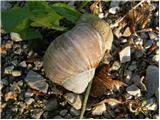 | Snail (Helix pomotia)
Usual snail grows up to 7cm and is very slow and mucous. It has a house with five turns and can hide in it when it's scared. It lives on meadows and damp forests and eats leaves and small insects. It ... |
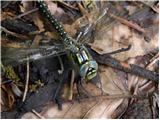 | Southern Hawker (Aeshna cyanea)
The Southern Hawker is a large and colorfully adorned dragonfly from the Aeshnidae family, measuring up to 76 mm in length, with a wingspan of about 9 cm. Adult males are recognizable by their black b... |
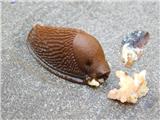 | Spanish slug (Arion vulgaris)
Spanish slug (Arion vulgaris)... |
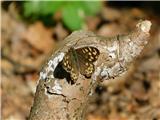 | Speckled Wood (Pararge aegeria)
The Speckled Wood is one of our most widespread diurnal butterflies, which hill-dwellers most frequently encounter precisely on forest paths. It is recognized by its dark brown wings sprinkled with pa... |
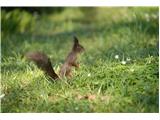 | Squirrel (Sciurus vulgaris)
Squirrel is on of the biggest rodents in Slovenia. Quick and shy animal has its home in forests. It has sharp claws on its fingers and it climbs on tree like an acrobat. Adult squirrel weighs about 40... |
| Talpa europaea
The common mole (Talpa europaea) is a species of animal that spends most of its time underground. It is distributed over most of Europe and parts of western Asia. While digging tunnels, it create... |
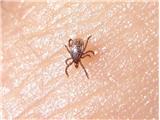 | Tick (Ixodoidea)
Ticks are small external parasites that feed on the blood of mammals, birds, and occasionally reptiles. Their body is basically strongly flattened, allowing them to move unnoticed through fur or under... |
 | Tree Sparrow (Passer montanus)
The Tree Sparrow (Passer montanus) is a smaller and somewhat more colorful relative of the house sparrow, which hikers often encounter on the edges of villages, in orchards, and along shrubby mountain... |
 | Triangulate cobweaver (Steatoda triangulosa)
The Triangulate cobweaver (Steatoda triangulosa) is a small spider from the cobweaver family, which hikers often notice in sheltered corners of mountain huts, under overhangs or in cracks of stone wal... |
 | Turdus torquatus
Ring Ouzel (Turdus torquatus) is a bird from the order of passerines and belongs to the thrush family.... |
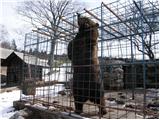 | Ursus arctos
The brown bear with the scientific name Ursus arctos is the king of our forests and one of the most powerful animal species that can be encountered in the Slovenian hills and vast Kočevje forests. It ... |
 | Vespula vulgaris
The common wasp (worker) is usually a little over 1 cm in size and is yellow and black in colour.... |
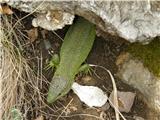 | Western green lizard (Lacerta bilineata)
The western green lizard with the scientific name Lacerta bilineata is one of our most beautiful and largest lizards, which with its emerald green color immediately catches the eye of every hiker. Adu... |
 | White stork (Ciconia ciconia)
The white stork (Ciconia ciconia) is one of our most popular migratory birds, which hikers often spot in the warmer part of the year on damp meadows, freshly mown areas, or while nesting in settlement... |
 | White Wagtail (Motacilla alba)
The White Wagtail (Motacilla alba) is one of our most recognizable birds, often encountered by hikers on alpine pastures, along mountain streams, and near mountain huts. Its appearance is unmistakable... |
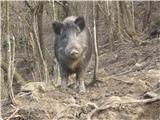 | Wild boar (Sus scrofa)
The wild boar is a forest animal that grows to 180 cm in length and weighs up to 200 kg. Characteristic for the wild boar is that it is an omnivorous animal as it feeds on insects, earthworms, hares, ... |
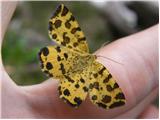 | Yellow Panther (Pseudopanthera macularia)
The Yellow Panther, also known by the name little tiger, is one of our most recognizable day-flying moths. Although technically it belongs among the nocturnal moths, it is active exclusively during th... |
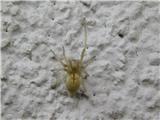 | Yellow sac spider (Cheiracanthium punctorium)
Yellow sac spider (Cheiracanthium punctorium) is considered the most venomous spider in our country.... |
 | Yellow-legged gull (Larus michahellis)
The yellow-legged gull (Larus michahellis) is our most common species of large gulls, which hikers encounter not only by the sea but increasingly also along larger rivers, lakes, and even near mountai... |