|
| kolesar8. 02. 2010 19:35:48 |
Great, but poles and crampons don't go together.
|
|
|
|
| lepenatka8. 02. 2010 19:48:29 |
They go together, why not? They don't bother me at all.
|
|
|
|
| JusAvgustin8. 02. 2010 19:50:56 |
try to stop with poles... When we put on crampons, ice axe goes in hand.
|
|
|
|
| Jany8. 02. 2010 19:53:50 |
That's right! They teach that in all beginner courses!
|
|
|
|
| JusAvgustin8. 02. 2010 19:58:20 |
When this becomes a habit and you can actually stop with the ice axe, then you can think about winter hills. Then comes meteorology, knowledge of avalanche conditions, making snow profile cuts... Otherwise the topic is for Begunjščica, beautiful mountain, definitely rules over the municipality of Radovljica, but Begunjščica is a bitch, has already taken many people... The gullies on Begunjska Vratača are wonderful. It's not called the mountain of a hundred gullies for nothing. It's not called the mountain of a hundred gullies for nothing.
|
|
|
|
| strelec195410. 02. 2010 18:21:24 |
Lepenatka is right, in case of heel crampons. Two or four tooth ones won't stop abruptly in a slip and throw you in the air like it happens with twelve tooth crampons.
With "real" crampons though really only with ice axe most important and that all season you practice stopping in a slip with safe runout because only then you have a chance to maybe stop in case of slip. Whoever has experienced a real slip knows that after three seconds of sliding you can't stop it anymore, until mother nature stops it.
Regards.
|
|
|
|
| JusAvgustin10. 02. 2010 18:45:05 |
I'm really curious who goes on winter ascents with two or four tooth crampons... every season [you] practice stopping, and I [do so] before starting the hike in mountains. Otherwise I already wrote once, if you fall on a slope with incline greater than 50 degrees no living christ stops you! every season [you] practice stopping, and I [do so] before starting the hike in mountains. Otherwise I already wrote once, if you fall on a slope with incline greater than 50 degrees no living christ stops you! 
Anyway the point is that when crampons go on feet, ice axe goes in hand without any exceptions , when descending we have ice axe in position that allows immediate reaction, in 2-3 seconds we can reach 60 km/h then it's no longer possible to stop the slip. Response time should be immediate! Practice stopping so long until we do it spontaneously. In any position. Coordination plays an important role here.
Of course talking about hiking ice axes.
|
|
|
|
| marko110. 02. 2010 22:42:36 |
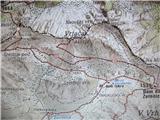
Hi! I won't be smart just seems to me that Zelenjak has two names Zelenjak or German Peak. Don't know asking you.?
 1 1
|
|
|
|
| andrejjerina10. 02. 2010 22:50:42 |
You are right, different maps just use different names, we all keep learning. Take it well. Best regards Andrej
|
|
|
|
| Gorazd G11. 02. 2010 15:28:17 |
Deutscher Berg is on the Karavanke 1:50,000 map a complete mistake. Of course I didn't make it up, it's written like that in Klinar's guide "Karavanke". In the book "100 Slovenian Peaks" we can read that the name Deutscher Berg is used for Vratača in Begunje, Žirovnica and surroundings. If it's true, locals know. On Zelenjak, as far as I remember, is the logbook of PD Tržič with this (correct) "green" name.
Anyway around Suho ruševje there's quite a bit of confusion with names. I wrote something about it here a good week ago:
http://www.gore-ljudje.net/novosti/52586/
Good luck!
|
|
|
|
| peterr11. 02. 2010 22:07:10 |
The name Deutscher Berg appears in this part of the Karavanke, according to Dr. Henrik Tuma's findings, on four different elevations. Most often at 2180m (Vratača).
In the magazine Gore in ljudje (Planinski Vestnik was renamed right after the war until 1948) several continuations of the article On the toponymy of the Stol group and in PV 1948 four more (Dr. Tuma collected and wrote the material in 1933). With the toponymy of this area also dealt extensively F.S. Finžgar, Koroški Slovenec Dr. Josip Šašel and Dr. Jakob Prešeren from Begunje (often not unanimous).
Interesting note in GL p.159/1: dispute over naming >>Deutscher Berg<< for (High) Vratača, which ignited after publication of this name in R. Badjura's Guide, was resolved by the geographical society committee at the university in Ljubljana in 1940 in the sense that the name Deutscher Berg should not be used, which appears to be a very recent designation, but to stick to those names used for peaks on the Carinthian side, where settlement began much earlier than in Carniola. This solution was also accepted by SPD with a decision to discontinue the use of Deutscher Berg in Karavanke in the future. From later implementations of Dr. Tuma it is evident that this name caused quite a confusion at a visible and exposed point of the state border (Šašel). Since the name Vratača for the mentioned peak was also accepted by our university's geographical institute, all reasons are given so that in the future scientists and tourists speak and write only VRTAČA (ed. note).
The name Deutscher Berg is thus located on four elevations:
1. 2180m (Vratača), so call it Smokučani who are owners of that alpine pasture, Badjura also names the peak so in his Tours, also in cadastre map.
2. On the hand map of Tržič branch SPD is recorded Deutscher Berg for 2027 m.
3. Military geographical institute in Vienna names Deutscher Berg before 1981m, now corrected to 1930 m.
4. Carinthian Germans name with some emphasis of national importance Deutscher Berg steep wall north of Veliki Stol, around 2103 m. Dr. Šašel names this elevation properly Belščica. The name shows all uncertainty of toponymy, which originates from shepherds from Carinthia and Carniola grazing criss-cross on former Carinthian-Carniolan border. German tourists transferred Slovenian Deutscher Berg their way, Slovenians never systematically reworked Stol group.
For elevation 1930m, before 1981m, now undisputed name Srednja Peč (Dr. Tuma GL 1947 p.212. On p.260 map Stol group).
Appendix in PV 1932 no.9 map Begunjščica.
There is much ambiguity in toponymy and reading old articles is often very interesting although due to different opinions you don't know what's most correct. Over time and usage some names change also due to different dialect on each side of Karavanke ridge.
Peter Rožič
|
|
|
You must log in to post a comment:
If you do not yet have a username, you must first
register.