|
| photo.Urban20. 11. 2011 20:57:02 |
Hello,
I'm wondering how marked trails are visible when a large amount of snow falls or when on some trails you no longer need to protect yourself with a self-belay harness etc. I mean, are the marks still visible, or do you have to go blindly?
best, U.
| (+1) |  | |
|
|
|
|
| blazek3320. 11. 2011 21:09:49 |
They aren't visible and that's the charm, you go where it suits you, you can even go across Krn Lake - in the pic 
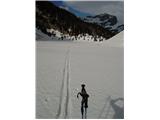 1 1
| (+1) | | |
|
|
|
|
| photo.Urban20. 11. 2011 21:14:22 |
Ideal that's what I like best any suggestion for New Year's climbing maybe?
|
|
|
|
| viharnik20. 11. 2011 21:31:07 |
Most often in winter, approaches to the mountains are made via winter variants due to avalanches and changed snow-terrain reliefs. Everything depends on the direction from which the snow is deposited, blown onto ridges, sun exposure, winds, amount and history of the snow cover, stable or unstable settling of the trail path, moisture, number of consecutive cold days (poor snow transformation) etc. Being safe in the mountains in winter can be a concept of true science and doctrine, which to the average mountaineer, among whom I count myself, is never fully apparent and understandable. The closest to studying avalanches was the meteorologist Vrhovnik (he planned the first avalanche station on Vogel). Later even he above Zadnji Vogel-Šija was buried by a snow avalanche. Therefore in suspicious conditions on a tour one must do an avalanche profile and test the snow cover. Of course there are no markings in winter except ski touring poles, so one must know the mountains and paths already from summer days. Protection is essential on all glacier tours and in possible ropes on harder summits.
| (+2) | | |
|
|
|
|
| keber121. 11. 2011 14:19:06 |
This bulletin/warning is only general, but it often misses the mark quite a bit, especially in more local conditions.
| (+1) | | |
|
|
|
You must log in to post a comment:
If you do not yet have a username, you must first
register.