Oberissalm - Innere Sommerwand (approach via glacier Sommerwandferner)
Starting point: Oberissalm (1742 m)
| Latitude/Longitude: | 47,09572°N 11,19491°E |
| |
Route name: approach via glacier Sommerwandferner
Walking time: 5 h
Difficulty: very difficult unmarked way
Elevation gain: 1380 m
Elevation difference along the route: 1380 m
Map: Stubaier Alpen Mitte, 31/4 1:25.000; Outdooractive Stubai Wanderkarte
Recommended equipment (summer): helmet
Recommended equipment (winter): ice axe, crampons
Views: 472
 | 6 people like this post |
Access to starting point:
From Ljubljana, we drive on the highway past Salzburg in the direction towards Munich. At the multilevel junction Dreieck Inntal we turn onto the road A93 in the direction of Innsbruck/Kufstein/Brenner. Upon returning to Austria we continue to the junction with the exit Innsbruck-Mitte. Here we don't turn towards Innsbruck, but we continue on the highway A13 in the direction towards the Brenner Pass. We leave the highway at the exit 10-Schönberg and follow the comfortable road through the Stubaital valley to the settlement Neustift im Stubaital, where at the roundabout in the middle of the town we choose the first exit and follow the ascending road to the village Milders. In Milders we follow the road Mühlenweg and signposts for Oberissalm. To the mountain pasture approx. 8 km of increasingly narrow asphalt road awaits us, on which livestock often roams, so the possible waiting time must be included in the estimated driving time. On the mountain pasture Oberissalm we park on the arranged parking lot, where the parking fee is 5 euros per day.
Alternatively we can drive through northern Italy: in this case from central Slovenia on the highway A2 we drive to one of the border crossings with Austria and we continue towards Lienz. Here we continue on the road 100 and past the passage Prato alla Drava we drive into Italy. In Italy we follow the road SS49 all the way to the junction with highway A22 in the direction towards the Brenner Pass. After the pass we continue in the direction towards Innsbruck to the exit Schönberg. From there we continue as described above.
Route description:
On the mountain pasture at the signpost above the parking lot we head onto a wide macadam road which in a few minutes of mostly flat walking towards the southwest brings us to a well-marked turn-off of a narrower footpath which with nice views on the eastern part of the Alpine ridge and mountain pasture Oberiss below us in zigzags relatively gently leads through thin high mountain forest. A little higher we pass onto a grassy area with high mountain alpine vegetation at the edge of the upper part of the Obergbach valley, and the steepness with nice views towards the Franz Senn hut and Vordere Sommerwand above it gradually decreases. Along a pleasant and panoramic path, which we follow in the last part of the path to the hut, past the mountain dairy on the mountain pasture Alpeiner through an attractive watery landscape in good fifteen minutes we ascend to the popular Franz-Senn-Hütte; from the starting point to the hut there is approximately an hour and a half of walking.
At the hut we follow a signpost which firmly directs us south on the path leading to the Sommerwandferner glacier, Vordere and Innere Sommerwand. Initially quite comfortable path winds over grassy slope and somewhat higher runs parallel to a torrent originating from the Sommerwandferner glacier. Over a partly rocky edge we approach the northern ridge of the Sommerwands and continue the path through rocky terrain below the eastern slope of Vordere Sommerwand. After approximately an hour of walking from the hut we come to a junction: along the marked path which turns sharply right towards the slope of Vordere Sommerwand, we can in good 20 minutes ascend to the lowest named elevation of the Sommerwand ridge, while the path towards the Sommerwandferner glacier continues straight south; at this point the path except for some old and faded specimen is no longer marked, and for orientation to the bottom of the glacier bold cairns assist us.
For some time we still relatively gently traverse below the Sommerwand ridge, then after a short ascent we descend towards the bottom of the glacial cirque. Following numerous cairns through rocky terrain we pass by the (in summer dried-up) glacial lake to the edge of the western part of the Sommerwandferner glacier. Caution: across the western part of the glacier towards Kräulscharte there usually leads a clearly visible track, and in this area there should be no crevasses; this cannot be unconditionally stated for the eastern part of the glacier below the Knotenspitzen, so we stick to the proven terrain.
Near the lowest point of the cirque below the Sommerwands the cairns at the edge of the snowfield somewhat scatter, and we look towards the next goal: an oasis of flat rocks in the middle of the glacier, above which we can spot visible footprints in the snow that will lead us below the Kräulscharte saddle. To avoid more demanding climbing over the cliff on snow right of the rocks we traverse to easier passable terrain, where we ascend to the rocks. Among relatively sharp rocks of the rocky band we can again track cairns which reliably bring us to the edge of the continuous glacier. Here we look upwards towards the obvious saddle above the western part of the Sommerwandferner glacier; in summer and autumn traces in the snow will likely ease the way to it, otherwise we traverse the moderately steep glacier towards southwest. Just below the saddle, when a nice view opens towards the Innere Sommerwand summit on the right, the steepness increases; in icy snow winter equipment is more than welcome here.
The difficulty of entering the rugged wall below the Kräulscharte saddle depends on the season or weather conditions: easiest in winter and spring, in summer and autumn we must climb some awkward rocks to reach the fixed rope which eases the ascent over the wall. With the welcome help of the rope fixed from above and some steps at the top we ascend over the moderately steep wall; without the rope aid it would be solid II grade. On the saddle, which connects the Sommerwand ridges and Kräulspitz, we turn right (west) and ascend along the fairly wide ridge to the natural passage between large jagged rocks.
At this point we have two options: to the summit we can push through the western or eastern slope below the mountain ridge. Substantially safer and more pleasant is the latter ("right") choice, as on the eastern side of the mountain one can relatively easily let oneself be guided by predecessors' tracks, and the most suitable approach direction is also indicated by bolts which appear at sufficiently short intervals to allow reliable belaying if needed. On the path we must climb a few short steps, and the climbing difficulty nowhere exceeds I grade. After approx. 15 min ascent from Kräulscharte through exposed and crumbly terrain (where the rock on the eastern side of the summit structure of the mountain is considerably less broken and unstable than on its western slope) we ascend to the cross on the panoramic summit in a very atmospheric high mountain environment.
The summit can also be reached via the western slope below the summit ridge, but due to great crumbly nature and associated objective danger I advise against it. To avoid risky ascent over broken crags, one can ascend to the step just below the summit via flat rocks (II).
Ascent to Innere Sommerwand is a high mountain tour requiring appropriate mountaineering experience: a sense of orientation is needed, as we mostly move in otherwise fairly clear but unmarked and quite remote terrain, and the demanding summit part is pathless, although decent orientation is possible at several points with the help of predecessors' tracks; if we follow the optimal ascent direction, (free) climbing in the upper part nowhere exceeds I grade, but if we are not overly concerned with finding the easiest passages, the climbing difficulty can increase markedly. Even though the glacier is relatively easily passable and uncrevassed in the western part, one needs at least basic knowledge of glacier travel, which is especially evident in more demanding weather conditions.
Nevertheless, Innere Sommerwand is among the technically easiest and orientationally least complex three-thousanders reachable in a fairly remote and still distinctly glacial world of the Alpine ridge. Precisely for that reason, the ascent to Innere Sommerwand can be an attractive excursion choice for a well-prepared mountaineer - on the summit we find ourselves in the heart of a remote world of vast glaciers, where few paths lead to peaks sharply rising above them.
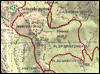
Along the route: Franz-Senn-Hütte (2147m), sedlo Kräulscharte (3069m)
Photos:
 1
1 2
2 3
3 4
4 5
5 6
6 7
7 8
8 9
9 10
10 11
11 12
12 13
13 14
14 15
15 16
16 17
17 18
18 19
19 20
20 21
21 22
22 23
23 24
24 25
25 26
26 27
27 28
28 29
29 30
30 31
31 32
32 33
33 34
34 35
35 36
36 37
37 38
38 39
39 40
40 41
41 42
42 43
43 44
44 45
45 46
46 47
47 48
48 49
49 50
50 51
51 52
52 53
53 54
54 55
55 56
56 57
57 58
58 59
59 60
60 61
61 62
62 63
63 64
64 65
65 66
66 67
67 68
68 69
69 70
70 71
71
Discussion about the trip Oberissalm - Innere Sommerwand (approach via glacier Sommerwandferner)
To post a comment you must log in:
If you do not yet have a username, you must first
register.