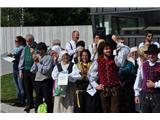
4th Day of the Alpine Convention 29.6.2013
1.07.2013
The main purpose of the Day of the Alpine Convention in Mojstrana on Saturday, 29 June 2013, was to draw attention to the sensitive
Alpine area, present the importance of the Alpine Convention and the peculiarities of Alpine valleys, the importance of preserving nature and
cultural heritage, and encourage visitors to visit Alpine valleys in an environmentally friendly way. For visitors,
the organisers prepared cycling in the beautiful Alpine valley, in Radovna and Krma, an internationally coloured
accompanying programme and a film evening the day before. The event, organised by Planinsko društvo Dovje-
Mojstrana, Triglav National Park, Alpine Association of Slovenia, CIPRA Slovenia, Hiša Pr Katr in cooperation
with the Ministry of Infrastructure and Spatial Planning and the Permanent Secretariat of the Alpine Convention, and which took place for the fourth time in Slovenia,
is the ONLY Day of the Alpine Convention in the area of Alpine countries and an example of exemplary cooperation
between various stakeholders in the Alps with the local environment.
The Alps are an area of numerous natural phenomena, landscape diversity, different cultures and languages. To protect this
exceptional area, eight Alpine countries and the European Community signed an international treaty – the Alpine
Convention, which supports sustainable development of the Alpine area, inclusion of the interests of the population and treatment
of the Alps as a single area. One of the important challenges in the Alpine area is also calming traffic in Alpine
valleys, so the organisers of Saturday's event wanted to remind visitors to the Radovna valley and Krma valley
that experiencing Alpine valleys is more beautiful for visitors and nature if we visit them by bike or on foot.
The film evening took place on Friday, 28 June 2013, in the Slovenian Mountaineering Museum, where a full hall
of visitors watched two films, CIPRA's For the Rock Hermit and the Powerhead and the winning film of this year's
international mountain film festival IMFFD 2013 titled Village, Far from Everything, which enthused the
audience.
The main event for the Day of the Alpine Convention was prepared on Saturday, 29 June 2013, when we organised
recreational cycling led by touring cyclists' guides of the Alpine Association of Slovenia from Mojstrana to
Radovna and Krma, a hike to Pocarjeva homestead with a workshop and film screening, and a rich accompanying programme
at the Slovenian Mountaineering Museum. We named the whole day »Through Alpine Valleys by Bike and on Foot – from
Mojstrana to Radovna and Krma!« For cyclists and hikers, transport was organised by train from Nova Gorica and
Ljubljana and bus from Jesenice to the venue in Mojstrana, experiential hike and guided cycling, visit
to the Slovenian Mountaineering Museum and Pocarjeva homestead (museum-arranged homestead and information post
of TNP), climbing on the climbing tower and demonstration of mountain rescue on the Grančišče wall organised by GRS
Mojstrana Association, and wonderful workshops for children Fairy Whisper of the Mountains with a visit from the paraglider, fortune-teller and witch
Anca and storyteller Bukovnik. This year's Day of the Alpine Convention was also intended to be dedicated to broader cooperation
of organisers with friends and municipalities in Slovenia and abroad. The programme was thus co-shaped with singing, dancing, music and sketches
by KUD Jaka Rabič Dovje – Mojstrana, the municipalities of Idrija (Alpine Town of the Year 2011) and Tolmin, and
partner parks of TNP: Biosphere Park Nockberge from Austrian Carinthia and Nature Park Julijsko predgorje from
Resia with presentation of their protected areas and cultural heritage of the Alpine area. At the event area, besides Idrija and Geopark Idrija, Posoški Development Centre and Tolmin, Biosphere Park
Nockberge and Nature Park Julijsko predgorje, the Tourist Association Dovje – Mojstrana, CIPRA
Slovenia, Alpine protection associations, Triglav National Park and the Permanent Secretariat of the Alpine Convention also presented themselves, where
visitors could get more information about the Alpine Convention.
All those gathered were greeted in the official part by the Mayor of the Municipality of Kranjska Gora Jure Žerjav, Director General
of the Directorate for Spatial Planning of the Ministry of Infrastructure and Spatial Planning mag. Tanja Bogataj, Director of Triglav
National Park mag. Martin Šolar, Vice-President of PZS, President of PD Dovje Mojstrana and Head of the Slovenian
Mountaineering Museum Miro Eržen and President of CIPRA Slovenia dr. Matej Ogrin, who emphasised the importance of such days
by drawing attention to the gems of Alpine valleys, sustainable mobility and joint cooperation in protecting the Alpine
area and nature in general. This year, at the end of May, the Day of the Alpine Convention was organised for the first time with the presentation
of the State of the Alps report on the topic of sustainable tourism in the Alps also in the area of Kamnik-Savinja Alps, namely
in the Solčava area. Both participants and organisers agreed that we will meet again next year.
The Alpine Convention is the world's first international treaty concerning a mountain area. It was concluded by the countries
of the Alpine arc: Austria, France, Italy, Principality of Monaco, Liechtenstein, Germany, Slovenia and Switzerland, and
the European Community. It means joint responsibility and a joint strategy for coexistence between nature protection and
management of its resources.
The Alps cover an area of 190,959 km², which measures 1,200 km in length and up to 300 km in width. The Alpine arc rises
from the sea and reaches the summit of Mont Blanc at 4,807 metres high. The Alpine mountain range extends across eight
countries, with Austria accounting for 28.7% of the total Alpine area, Italy 27.2%, France 21.4%, Switzerland 13.2%,
Germany 5.8%, Slovenia 3.6%, Liechtenstein 0.08% and Monaco 0.001%. The goal of the initiators of the convention is to protect
the Alps as a living and economic space, cultural, linguistic and landscape diversity. The Alps with their
biodiversity, water and forest resources, natural, cultural and economic environment, home to almost
14 million people and an attractive tourist destination for about 120 million visitors annually. The Alpine
Convention strives for sustainable tourism and sustainable development of the Alps with all its characteristics. It also strives
to reduce traffic loads, therefore promoting more nature-friendly visits to the Alps using
public transport and with special traffic arrangements in Alpine valleys. The Alpine Convention and its protocols
actually represent instruments of sustainable development of the Alpine area and propose a uniform development concept
that would prevent competitive struggle from taking place at the expense of nature and ultimately to the detriment of people. With joint
efforts, methods must be found that will manage the limited resources in the mountain area in the most
economical way and without consequences for future generations. The implementation of the convention's efforts in practice is
certainly also the Day of the Alpine Convention.