Adapting our habits to preserve the nature of Triglav National Park...
3.06.2022
We adapt our habits to preserve the nature of Triglav National Park.
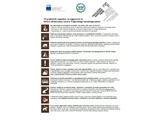
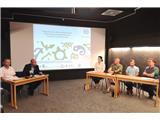
Partners of the VrH Julijcev project presented ten practical tips for responsible and careful visiting of Triglav National Park's nature on 3 June in Bled, before the start of the summer season. Among the numerous novelties enabled by project funds are the renovated educational trail of the Goreljek bog, and works are already underway for the renovation of the Pokljuka Trail and the new information point at Mrzli studenec.
The VrH Julijcev project - Improving the status of species and habitat types in Triglav National Park is co-financed by the European Union from the European Regional Development Fund and the Republic of Slovenia. The project involves 7 partners from the sectors of nature conservation, forestry, agriculture, mountaineering and tourism with the aim of improving the state of nature. A wide range of activities includes adapting human activities to preserve the habitat of seven animal species, one plant species and three typical habitats (habitat types) of Natura 2000, which are important at the European Union level. For all of them, the status in TNP is assessed as unfavourable or poor. Dr. Tit Potočnik, director of JZ TNP, emphasised that the public institute is an important connecting link in the space between different sectors: "Only through close intersectoral cooperation, involvement of landowners and local communities can we implement all five management areas of TNP. Different interests in the space have a common point, namely that we want to preserve nature, as this alone brings sustainable development to this space."
Due to the coronavirus situation, they managed to extend the project until the end of 2023. Project leader Andrej Arih from JZ TNP presented the key areas for the summer season at a press conference, with which they aim to reduce traffic pressure and direct visits. "Calming traffic in the summer season is the central activity to ensure peace and a safe space for wildlife during the period when they raise their young. Public transport, organised car parks, which are also limited in nature, and in some areas barriers for time-limited access are ways to ensure peace for these rare species that the national park can boast about." Arih adds that they are also establishing information points in six mountain huts for better knowledge of species such as capercaillie, rock ptarmigan, forest grouse, three-toed woodpecker, hazel grouse and two amphibian species (Alpine newt and mountain newt). In total, they have installed more than 50 new information boards in the park area, renovated the Goreljek educational trail, which protects the most sensitive part of the high bogs. Works are underway for the renovation of the Pokljuka Trail and the installation of a new information point at Mrzli studenec.
Quiet zones are a way to ensure peace for nature
To preserve the habitat of the capercaillie in the forest area, they have established 19 quiet zones. All are marked with signs, and for some there are barriers on forest roads that ensure controlled vehicle traffic, especially during the most sensitive breeding period. The Slovenian Ornithological Society (DOPPS) in cooperation with TNP carries out monitoring of capercaillie and rock ptarmigan, which also includes year-round tracking with telemetry transmitters. Results for rock ptarmigan show that it is strongly tied to the high mountains, especially in winter to steep areas and rock walls where it finds herbaceous vegetation. Males stay near females until the young hatch. Then the female cares for the brood alone and mostly stays with the young on grassy plateaus.
Interim analyses of telemetry transmitters on capercaillie specimens show the impact of visitors' presence on its movement. It avoids mountain trails at a distance of more than 150 metres, and in summer and autumn it descends right below the forest line.
Partner of the VrH Julijcev project, the Slovenia Forest Service (ZGS), planted 13,000 seedlings of fruit-bearing woody vegetation for the protection of capercaillie on Pokljuka and Mežakla, which is an important source of its food. Brigita Oblak from ZGS said: "Last year we thinned 15 hectares of brushwood and shrubs in the area of Fužinske planine. On Pokljuka, we cleared woody growth on 61 km of clearings between economic compartments. This has improved the habitat for capercaillie as well as other free-living animal species."
Let the visit to Triglav National Park be a footprint that contributes to the preservation of the nature of Slovenia's only national park
Tourism Bohinj, as a partner in the VrH Julijcev project, sees an opportunity for concrete traffic solutions especially in the summer season. "Triglav National Park is one of the most visited parts of Slovenia in the summer season. We plan nature visits appropriately for our own safety and responsibility towards the space. With appropriate planning of TNP visits, we significantly contribute to the quality of life of locals, our own good experience and the preservation of the valuable natural heritage of Slovenia's only national park," explained Klemen Langus, director of Tourism Bohinj and coordinator of the Julian Alps Community, adding: "This year too, from 1 July to 20 September, we will establish free bus services from major car parks to the most visited mountain starting points on Pokljuka and back." Buses will run from 6.50 a.m. to 7 p.m. They also see great potential for sustainable development in greater use of rail transport, especially on the Bled-Bohinj route, which is co-financed by the Triglav National Park Public Institute.
The Alpine Association of Slovenia also joins the encouragement for greater use of sustainable mobility means. Dušan Prašnikar, professional associate of PZS, emphasised that mountaineers are traditionally considered to have a caring attitude towards nature: "However, in recent years we have been facing a higher number of visitors, which puts us all before a common task to adapt our habits so that the footprint of our mountain visits is minimal." Prašnikar also presented PZS's activities so far in the VrH Julijcev project: "PZS wants to act primarily preventively, i.e. through education, training and awareness-raising. Within the VrH Julijcev project, we will train more than 70 guardians of mountain nature, and so far we have already trained 370." They cooperate with VrH Julijcev project partners on the production of a documentary-educational film about Triglav National Park.
In previous years, the action of the Institute of Slovenia Fishery, which carries out fish removal from Dvojno jezero, has attracted a lot of attention. Miha Ivanc from ZZRS had just returned from the first working action of 2022 and presented the current situation at Dvojno jezero. "Fish removal has been going on for the third year in a row. The work is primarily demanding due to the difficult access location where all equipment needs to be brought. Both fish species - lake trout and char in the high-altitude lake are deteriorating the ecological status of the lake. Planktonic crustaceans and aquatic insect larvae, which the fish feed on, have disappeared. Consequently, algae have also started to proliferate," explained Ivanc and added: "We carry out removal using various methods such as electrofishing, kogoli (special traps that guide the fish into the creel using a guide) and stabbing nets. The latter have proven to be the most effective, but in summer algae accumulate on them." This makes them visible to the fish and thus ineffective - so they have to devote a lot of time to daily cleaning of the nets. To reduce algae, the TNP Public Institute will also remove vegetation at Dvojno jezero this year. In cooperation with PZS, they will continue to obtain permits for upgrading the sewage treatment plant at the hut at Dvojno jezero.
In autumn, they plan to renovate 17 wallows on alpine pastures
Mountain pastures and alps have shaped a unique habitat for bird and amphibian species and plants over decades. This is an important habitat for protected and rare amphibians such as the Alpine newt and mountain newt. The Kranj Agricultural and Forestry Institute will renovate 17 wallows in the VrH Julijcev project this autumn, and woody vegetation removal will also take place to preserve mountain farming in Triglav National Park.