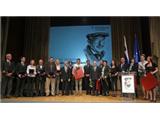
Awarding of the Bloudek plaque for lifetime achievement in sports
12.02.2011
Yesterday, on 11 February 2011, the awarding of the Bloudek awards took place in the Union Hall of the Grand Hotel Union in Ljubljana, where the attendees were also addressed by the Prime Minister of the Republic of Slovenia, Borut Pahor. Among the recipients of the Bloudek plaque for lifetime achievement in sports was also our alpinist, mountain rescuer, publicist and writer Tone Škarja.
The Bloudek award for outstanding international sports achievements was received by skier Tina Maze, judoka Lucija Polavder and boxer Dejan Zavec. Rolando Pušnik for exceptional contribution to the development of Slovenian sports and chess player Milan Kneževič for lifetime achievement and exceptional contribution to the development of sports in Slovenia.
The Bloudek plaque for lifetime achievement in sports was received, in addition to our Tone Škarja, also by David Antončič, former sailing representative, and Jože Šlibar, former world record holder in ski jumping. Among the recipients of the Bloudek plaque were also kayaker and medal winner from the World Championships in Tacen Jure Meglič, European champion in boules Davor Janžič, holder of numerous medals from World Championships in bowling Rada Savič and Miha Zupan, the first professional deaf basketball player in the world, excellent competitor in skiroll and roller skating Mateja Bogatec for important contribution to the development and popularization of Slovenian expatriate sports, athlete Igor Primc for important contribution to the development and popularization of Slovenian sports, and the Sports Association Sonček, which for more than 15 years with its actions inspires young athletes.
Who was engineer Stanko Bloudek and why are the awards given?
Engineer Stanko Bloudek (born in Idrija on 11 February 1890, died in Ljubljana on 26 November 1959) was the personality who has most prominently and significantly influenced the development of physical culture in Slovenia and, within that, especially the growth of Slovenian sports. He was an aircraft designer, sports organizer and director, himself an active athlete, builder of sports facilities in Slovenia (including the ski jumping hills in Planica) and in various countries across Europe.
Bloudek awards (award and plaque) are the highest state recognition of the Republic of Slovenia, awarded since 1965 by the Committee for the Awarding of Bloudek Awards for achievements in the field of sports. The Bloudek awards are regulated by the Law on Bloudek Awards.
The greatness of Stanko Bloudek's personality is illustrated by an anecdote from 1930, when a swimming championship was held at one of the most modern swimming pools in Europe at the time – his Ilirija.
"In the new Ilirija pool, the competitions for the Slovenian swimming championship were held for the first time under new conditions. The leadership of the swimming association, which was in the hands of members of Primorje, tried to harm Ilirija with irregular decisions and invalidations of achievements made in the water, as was customary at swimming championships in general. Bloudek watched this behavior calmly for some time, then it boiled over and with a single gesture, although he was not involved in the judging or leadership of the competition, he put an end to it. 'Out of our water!' he ordered and in the afternoon no longer allowed the competitions to continue in the pool. They calmed him only the next day and persuaded him that the competitions, which were in his pool, could continue, and the judges reconsidered and then led the competition to the end in the spirit of sports fairness." (Excerpt from the book: Drago Stepišnik: Stanko Bloudek, Državna založba Slovenije, 1971)
And why did Tone Škarja, alpinist, mountain rescuer, publicist and writer, receive the Bloudek plaque for lifetime achievement?
Tone Škarja represents the pillar of Slovenian alpinism, who with his active involvement significantly contributed to its establishment in the world. The otherwise small number of alpinism adherents in the Slovenian area (currently 526 registered in the PZS) he successfully led from the first ascents in domestic mountains, through the Central Alps, to the arena of world alpinism, the Himalaya. With firm work, planning and anticipation based on experience, he quickly established himself with a strong team and surpassed the world elite. The ascent via the west ridge to the summit of Everest still resonates greatly in the world, which is impartially described in the book Everest - the Mountaineering History by author Walt Unsworth from 2000. Despite being a top alpinist himself, he never exploited his position; on the contrary, he gave opportunities to everyone who had the will to work. Under his leadership, Slovenians were the first to start climbing high mountains in alpine style (from base to summit in one push, without intermediate camps), which is today the most valued way of climbing. For thirty full years he has led the Commission for Expeditions to Foreign Mountains, which arose precisely because of divisions among alpinists and the fear that new expeditions to foreign mountains would not even happen.
In short, his entire life is connected with alpinism and spanned between his home town, the Mountaineering Association of Slovenia and the then Mountain Rescue Service. He dedicated all his time to organizing alpinist expeditions, which in the time of the then social system and transport possibilities was not easy, to lead Slovenian alpinism to the very top.
The Mountaineering Association of Slovenia receives bulletins of events in the field of world alpinism every year (American Alpine Journal, The Himalayan Database of Elisabeth Hawley), in which the name of our country appears every time and behind every such name stands also the work of Tone Škarja.
Achievements or successes due to which Tone Škarja was proposed for the recipient of the Bloudek award
- head of the Commission for expeditions to foreign mountains since 1979, which contributed world recognition to Slovenian alpinism. Without his selfless and fair leadership of such an important part of the Mountaineering Association of Slovenia as expeditions to foreign mountains, Slovenian alpinism today would not be at the very top of the world. With planned direction and a quality leadership team, he succeeded in having first Yugoslavia and then Slovenia, in just a few years, go from nothing to top ascents in Himalayan walls, which due to the specific environment and great altitude are considered the most difficult in the world. Numerous individuals who distinguished themselves in climbing alpine walls got the opportunity and we can claim that without his presence Slovenia would not have three Golden Ice Axes (Piolet d'Or), which are the highest recognition in alpinism.
- he is a successful publicist with numerous critical articles in the field of mountaineering and alpinism and writer of literary works, in which he authentically presents alpinism: from paths, life in base camp, work on the mountain, to happiness and tears on the summit, sorrow over the loss of a friend ...
Excerpt of his works from COBISS (listed by France Malešič):
1972, 1974, 1984 - Hoja in plezanje v gorah - co-author Tine Mihelič - handbook - Planinska zveza Slovenije, Ljubljana, three editions
1975 - Stene mojega življenja - monograph - Obzorja, Maribor
1976 - Kangbačen - co-authors Jože Andlovic, Stane Belak, Danilo Cedilnik, Janez Dovžan, Zoran Jerin, Franc Jeromen, Bojan Pollak, Roman Robas, Peter Soklič, Tone Trobevšek - monograph - Mladinska knjiga, Ljubljana
1979 - Na vrhu sveta - co-authors Jože Andlovic, Danilo Cedilnik, Aleš Kunaver, Matjaž Maležič, Franci Savenc, Ante Mahkota - anthology - Mladinska knjiga, Ljubljana
1979 - Na vrhu svijeta - co-authors Jože Andlovic, Danilo Cedilnik, Aleš Kunaver, Matija Maležič, Zoran Jerin, Franci Savenc, Ante Mahkota - anthology - Mladinska knjiga Zagreb, Globus
1981 - Everest - co-authors Stane Belak, Ivan Kotnik, Marjan manfreda, Vanja Matijevec, Dušan Podbevšek, Roman Robas, Andrej Štremfelj, Marko Štremfelj, Igor Tekavčič, Nejc Zaplotnik - monograph - Mladinska knjiga, Ljubljana
1987 - Jalung Kang - monograph - Borec, Ljubljana
1992 - Stoletje v gorah - co-authors Jože Dobnik, Božo Jordan, Marjan Raztresen, Pavle Šegula, Danilo Škerbinek, Albin Vengust, Kazimir Rapoša, Franci Savenc, Franc Vogelnik, anthology on the centenary of PZS - Cankarjeva založba, Ljubljana
2002 - Zgodovina reševanja v gorah nad Kamnikom - co-authors France Malešič, Cene Griljc, Vlasto Kopač, Miro Štebe - monograph - Planinska zveza Slovenije, Ljubljana
2003 - Planinski zbornik, Ob 110-letnici Planinske zveze Slovenije - co-authors Franc Ekar, Matjaž Deržaj, Tone Strojin, Stanko Klinar, Jurij Dobravec, Anton Ramovš, Janez Duhovnik, Bine Mlač, Tomo Česen, Danilo Škerbinek - anthology - Planinska zveza Slovenije, Ljubljana
2004 - Slovenci v Himalaji - Slovenians in Himalaya - bilingual monograph - Planinska zveza Slovenije, Ljubljana
2008 - Kangčendzenga, gora usode - monograph, Didakta, Radovljica
- he has been climbing since 1956 and is known for numerous first ascents that represented milestones of the time and by which young people still look up today. The following is a list of some of his most important ascents:
Kalška gora: Direct entry variant in the Northeast gully
Zajeda (Humar-Škarja route)
Kalški greben - north wall: winter, solo
Kogel: Kamniška route
Skuta: Direct route over Plošča, Right pillar in the north wall, first winter ascent
Štruca: Direct route
Dolgi hrbet: Šimenc-Škarja route, Trikot, Saša Kamenjev route
Brana:
- west wall: White pillar, Bos route, first winter ascent, Orion, first ascent, winter
- east wall: Central route, first winter ascent, partially first ascent
Planjava:
- north wall:
Drofenikova-Tschadova, first winter repeat with Metod Humar, Drofenikova: first winter ascent, solo
- southeast wall: Humar-Škarja
Ojstrica:
- south ridge: Gully to the Shoulder
- east wall: winter, solo
Zadnji Prisojnik: Direct route, first winter repeat
Alps - more important ascents:
Mt. Blanc: night traverse, solo
Mt. Blanc du Tacul: Gabarrou-Albinoni
Mt. Blanc - Dent du Requin: Rébuffat-Couttet
Grands Chamoz: Welzenbach-Merkl, direct exit Heckmair-Kröner
Aiguille Verte:
- northwest wall: Charlet-Platonov
- northeast wall: Couturier, solo
Aiguille du Midi: Cosmic ridge, solo
Les Droites: Entry variant to the north gully, first ascent
Sattelhorn: Direct entry, first ascent
Les Courtes: Northeast gully
Austrian, solo
Swiss route
Weisshorn: North wall
Monte Rosa, Nordend: Direct route
Mont Blanc du Cheillon: North wall
Breitlauihorn - Tyfelsgrat: North rib, first ascent
Lonzahörner: North wall
Aiguille du Chardonnet: Migot pillar, in rope team and solo
Pic sans Nom-Coup de Sabre: North wall, solo
- he was the leader of numerous alpinist expeditions, which is the most demanding role of an individual on an expedition. Without quality leadership, quick and thoughtful decisions, there is no successful expedition to the summits. As his greatest achievement we can count the Yugoslav expedition to Everest in 1979, when they were the first to climb the west ridge of Everest. On the mountain they fixed 11 km of ropes, and through the initial part they transported equipment with a hand cableway. The route has been repeated to this day, despite numerous attempts by the best alpine nations, only by the Bulgarians and even that not in the original. Appendix 1: List of Tone Škarja's expeditions.
- between 1968 and 1978 he was head of the Mountain Rescue Service station Kamnik. In this period he consolidated discipline and ensured further growth in the quality of rescuers' work, and improvement of rescue technique and skills of modern alpinism.
- member of the Mountaineering Association of Slovenia since 1955
- alpinist since 1956
- mountain guide since 1993
- in the mountaineering organization he actively participated as:
- vice president of PZS, 1998
- editor of PZS Notices, Planinski vestnik and mountaineering calendar
- initiator and caretaker of the Slovenian part of the Nepalese Mountaineering Museum.
Previous awards of Tone Škarja in the field of sports:
1987, Honorary sign GRS 25 years
1964, Silver honorary sign PZS
1965, Golden honorary sign PZS
1974, Golden honorary sign PZS
1997, Commemorative plaque PZS
1979, Golden sign PSJ (PSJ - Planinarski savez Jugoslavije)
1965, Silver sign PSJ
1997, Meritorious sign GRS 35 years
2002, Solemn charter PZS
2005, Commemorative recognition - Čopov steber
2009, For exceptional contribution to mountaineering