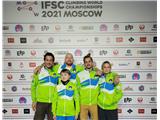
Glušič second in Moscow, Smrekar and Selak just off the podium.
20.09.2021
Glušič second in Moscow, Smrekar and Selak just off the podium.
At the Paraclimbing World Championships Moscow 2021, Slovenian representatives Manca Smrekar and Gregor Selak finished fourth, while Matej Arh concluded the WC in sixth place. Tanja Glušič was reclassified into the masters category, where she took second place. Despite good performances, the paraclimbers are returning home with a bitter taste.
The Moscow 2021 World Championships is this year's most important challenge for the Slovenian paraclimbing team, which, thanks to Glušič and Selak, can boast five precious medals from previous world championships. Unfortunately, this year their dreams stopped short of the podium, as Smrekar and Selak missed out on a medal in the RP3 upper limb dysfunction category due to a mistake in the evening final on September 17, while Glušič and Arh had their plans disrupted on September 15 by a new paraclimber classification, which moved Tanja from the permanent B2 visual impairment category to B3, which was only run as a masters competition and not as a WC event, and Matej from RP1 to the RP2 upper limb dysfunction category.
Manca Smrekar (AO PD TAM Maribor), who excelled in qualifications with excellent climbing, climbed to fourth place in the RP3 upper limb dysfunction category at her first world championships. "In qualifications, I surprised even myself with my climbing to reach third place, so I hoped for a better placing in the final, where I was disappointed with my climbing, as I hoped to go a bit higher. Maybe the route wasn't meant for me or I wasn't prepared enough, although I really gave it my all in the last two months. Still, I'm extremely happy to have climbed in the final," summarized the newcomer to the team, 29-year-old from Ljubljana, who has dysmelia, missing some fingers on her hand.
The most experienced team member Gregor Selak (Društvo za razvoj plezalne kulture), who won a bronze medal at the previous three world championships (2016 in Paris, 2018 in Innsbruck, and 2019 in Briançon), was denied a medal in the RP3 upper limb dysfunction category this time by a mistake in the final. "The final routes were very well set, but unfortunately I made a mistake. I read it correctly, but climbed wrong, with the wrong hand forward, as I got scared of the move, started to barn-door, and fell. Bad!" the 32-year-old from Škofja Loka, a former member of the youth sport climbing team, who was diagnosed with multiple sclerosis in 2014 and has successfully continued his sports career as a paraclimber since 2016, could not hide his disappointment.
"After the final performance, we're a bit disappointed because Manca and Gregor achieved their worst result in the final, but overall, two fourth places is a very good achievement, and I think once we sleep on it, we'll be satisfied with it too, even though today maybe the holds didn't go to the right hands," commented their performance and the overall haul from the world championships by the selector of the Slovenian paraclimbing team, Jurij Ravnik.
Tanja Glušič (AK Ravne), deafblind climber with Asperger's syndrome, took second place with excellent climbing in the masters, but the bitter taste remains that she didn't have the chance to climb at the world championships. "I climbed the first route to the top, I'm very satisfied, also with the second route I'm satisfied, I got quite far, even though I couldn't train for a month due to injury, muscle inflammation from wrist to elbow. I'm happy with second place, but not satisfied with the classification, because they didn't put me in the B2 category, where I would have qualified for the final, even if they combined us as in the World Cup. I feel a bit cheated," said the 25-year-old from Carinthia, who was fifth at the WC two years ago and brought Slovenia two paraclimbing medals from world championships - silver in 2014 in Gijón and bronze in 2018 in Innsbruck.
Due to blindness, Glušič needs coach Jurij Ravnik for climbing, who guides her and gives her instructions for progressing on the wall, which she hears with the help of a cochlear implant. "Tanja, after a very difficult season with a host of injury problems, managed to put together a winning form just for the championships. She climbed both routes excellently and would have qualified for the final in the combined B1 to B3 category, as was usual this year in the World Cup. Unfortunately, she was a victim this year of incomprehensible IFSC bureaucracy, constant changing of rules that no one understands anymore. First they moved her to B3, then they decided to combine only B1 and B2, and run B3 only as masters. I can congratulate her and I'm proud of the second place, but IFSC should be ashamed in my opinion. Anyone can watch the videos of competitors whose experts think see worse than Tanja, even though they look and precisely step on every hold, climb even faster the second time, do dynamic moves and the like, which Tanja and some other competitors simply can't," Ravnik was disappointed.
Matej Arh (AO PD Kranj) qualified sixth in qualifications at his second world championships, missing the final by just a move and a half. "Overall, I'm satisfied with the world championships. I knew I needed a perfect day to have a chance of qualifying for the final, but I didn't have it. I had a good day and the placing somehow reflects my current level in this category," assessed the 27-year-old from Gorenjska, once a promising alpinist, who has paraparesis, partial spinal cord interruption from an accident in an iced waterfall, due to which he uses only 30 percent of muscles from the navel down, can partially move his legs, but cannot use hips, ankles, glutes, and most muscles. "Matej also climbed solidly in Russia, on the edge of the final, but just a little short. Certainly, on a better day he could have surprised, but this time it didn't go as wished. He's also in a very tough category given the paraparesis. For example, an American with identical injury is classified in RP1, so you first have to hit the 'classification lottery'. In any case, I congratulate him too for the fighting performance," said selector Ravnik.