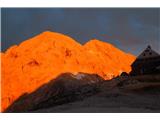
International Mountain Day: Mountains are Changing
11.12.2025
The General Assembly of the United Nations declared December 11, 2003, as International Mountain Day, and we have been observing it worldwide ever since. The Alpine Association of Slovenia (PZS) prepares a message every year for this day, whose theme this year is: Glaciers are important for water, food, and survival in the mountains and elsewhere. The author of this year's message is PZS vice-president Martin Šolar.
Mountains are changing. In many respects. In the light of climate change, we cannot overlook the disappearance of glaciers, rockfalls and constantly falling rocks, extreme drought periods that dynamically alternate with heavy precipitation events; the consequences are debris flows and landslides with flash floods in the valleys below the mountains. All this influences changes, harmful events; the aforementioned affects the safety of people who go into the mountains, and ultimately the consequences of climate change pose a challenge for managing alpine infrastructure such as trails and huts.
The disappearance of glaciers in the Alps is practically visible, as one might say, to the naked eye. Drinking water reserves are diminishing, moraine surfaces are becoming increasingly unstable, in higher elevations permafrost is drastically decreasing, and consequently, the stability and safety of high-altitude alpine infrastructure is highly questionable. Sections of engineered trails, some huts or bivouacs may no longer be safe. This may seem like a fantasy world for Slovenian conditions, but in the neighboring hills with peaks just over 3,000 meters, these are serious facts.
Erosive phenomena and damage to trails are not merely the result of mass visitation. Heavy rains, collapses, and falling rocks cause faster mechanical changes in the bedrock and, of course, direct, immediately visible damage to trails, which must be maintained for safety and ultimately for the existence of this infrastructure. Will we succeed in this, or will the effects of climate change outpace us? A special challenge is also the growing water shortage needed for operating alpine huts. There is less water; theoretically, there will also be less polluted wastewater, which must not stop us from seeking effective solutions for discharges in huts.
Mountains or mountain ecosystems cover a good quarter of all land on Earth and are home to more than half of all species on the planet. Water sources, food, people who live there—they are part of the mountains. Mountaineers, visitors, and tourists also claim the mountains. Yet the mighty mountains are indeed changing before our eyes and showing us their sensitive and fragile face.
The importance of mountains is not just as a goal and motive for conquerors of the useless world; the importance of mountains is manifold. In 2002, the United Nations declared it the International Year of Mountains. Many resonant actions at that time prompted the General Assembly of the United Nations to declare December 11 the following year as International Mountain Day. With a responsible attitude toward mountains, awareness of the consequences of climate change, and considerate visits and behavior, we can help reduce pressures on nature in the mountain world. We probably cannot stop climate change and glacier shrinkage, but we can contribute to understanding and raising awareness of this year's central theme of International Mountain Day, which is: Glaciers are important for water, food, and survival in the mountains and elsewhere. International Mountain Day is marked on December 11; special emphasis on the central theme in Slovenia is once again given to the Brati gore action.
Mountains are changing due to the impacts of climate change, increasing risks for mountain visitors. But mountains are also changing in the eyes and capabilities of us ourselves. For young people who have just left their childhood years, mountains are a challenge and suddenly not steep enough or high enough. For others, mountains are majestic, but with age they become too steep and too high. Mountains are changing, and let us respect them as they are!
mag. Martin Šolar, vice-president of the Alpine Association of Slovenia