7.01.2014
Osp and Osapska Wall – natural pearls important for Slovenian climbing.
Following the recent rough intervention by climbers in the Grad cave near the village of Osp, as reported by Primorska Chronicle (TV Slovenia, 3. 1. 2014), we at the Alpine Association of Slovenia were horrified. The AAS is indeed aware of the problems in this valley and is strongly committed to resolving them, also with the assistance of climbers, the local community, and the Municipality of Koper.
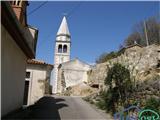
Significance: Osapska Wall is a distinctive semicircular overhanging wall that formed as a result of the collapse of a former cave ceiling; it is the trademark of Osp, one of the oldest villages in Slovenia. During Turkish invasions, it provided shelter for residents; today, it represents an exceptional climbing crag. The favorable coastal climate enables climbing year-round, and due to the mild climate and large selection of diverse routes of all difficulties, Osp ranks at the top of Slovenian climbing offerings. The rock quality, ranging from sharp and pad-unfriendly to dripping stalactites with super holds, offers great pleasure to vertical enthusiasts, so it is no wonder it attracts climbers from the local and wider area, as well as from around the world.
Historical overview: The climbing area of Osp walls and Mišje peči has a long tradition and historical significance for the development of climbing in Slovenia. Climbers have been visiting for over thirty years. Osp is among the oldest Slovenian crags, and due to quality routes and Mediterranean climate, these walls have ranked among the top 10 European climbing destinations for decades on a European scale. Since 1977, when the first routes were established in Osp, the number of climbers has dramatically increased, and free climbing has developed into one of the fastest-growing modern sports. Initially, the walls attracted alpinists, especially to the big Osp wall, where they climbed mainly using technical aids. The free repeat of Magic Mushroom (Tadej Slabe-Srečo Rehberger team) in 1986 was undoubtedly a breakthrough that introduced the valley to the broader Slovenian public. National television broadcast the free repeat of Magic Mushroom live. For climbers, this free repeat was a milestone, as the team proved that overhangs can be climbed freely (without technical aids) and routes that previously represented the limits of technical climbing can be repeated. Osp is also considered the birthplace of the national sport climbing championship, as the first national sport climbing championship took place in the walls behind the village in 1988. Osapska Wall and the valley are otherwise also important for the development of Slovenian climbing, as routes in the Mišje peči overhangs represented unprecedented development and momentum for Slovenian climbing, which soon influenced global climbing powers. Tadej Slabe attracted the world's best climbers in the early 1990s with the route Za staro kolo in majhnega psa (8c+).
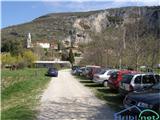
Issues: With the boom in sport climbing in the valley, the number of visitors—climbers in the Osp wall and valley—has greatly increased. Unfortunately, this development has brought certain problems, which we at the Alpine Association of Slovenia are acutely aware of. The issues primarily involve parking problems, sanitation, wild camping, and discarded trash. On nice weekends, Osp and Črni Kal are visited by several hundred climbers, typically 20-30% of whom are foreigners. During Easter, May Day, and autumn school holidays, due to increased foreign visitors and insufficient supporting tourist infrastructure capacities, especially organized parking and accommodation, the situation becomes untenable.
Efforts of the Alpine Association of Slovenia and addressing the issues: The AAS strongly condemns the actions that occurred in Grad cave. The rough intervention in Grad cave was not carried out as part of any AAS-organized activities. In the Primorska Chronicle report on TV Slovenia, the AAS position was not fully presented; specifically, with the provided statement, we wanted to emphasize that there is no legislation in Slovenia determining rules for bolting new climbing routes in crags and that the AAS has no authority to decide who can bolt climbing routes. However, the AAS strives for appropriate legal regulation of the establishment, maintenance, records, conditions, and stewardship methods for organized sport climbing crags in nature. We are also aware that equipping climbing routes in protected areas must be carried out particularly carefully and in agreement with competent organizations.
The AAS has been working to regulate conditions for climbers in Osp for quite some time. Since early December 2013, the AAS in collaboration with the Municipality of Koper is also preparing a meeting on regulating conditions for climbers in Osp. The meeting is scheduled for January 2014, and we plan to invite as many relevant parties as possible, primarily landowners and Osp residents.
The AAS, as an organization with its commissions, clubs, and individual members, strives for nature conservation, which is one of the core tasks of our mountaineering organization. Among other things, over 25 years ago we launched the "Take trash with you down the valley and home" campaign, which has resulted in significantly cleaner mountains, particularly in the awareness of mountain visitors about protecting mountains, nature, and caring for them. Therefore, the AAS does not advocate that everything is permitted in the walls; instead, even in walls that are part of our wonderful rocky world, one must act in accordance with rules for protecting and preserving the natural environment.
The Alpine Association has also repeatedly warned via its own and other online media ahead of expected large influxes of climbers to Osp to strictly adhere to parking rules, exercise patience, protect nature, and suggested that climbers choose other nearby crags in such cases.
The AAS recommends that all who wish to equip climbing routes in crags attend the course for sport climbing route equippers, held under the AAS Sport Climbing Commission, to acquire the necessary knowledge for these activities.
President of the AAS Bojan Rotovnik