PZS Expedition - Phola Gangchen 2013
2.09.2013
The alpine expedition PZS PHOLA GANGCHEN 2013 with the Slovenian youth alpine national team is setting off.
On Sunday, 8 September 2013, from Jože Pučnik Airport at Brnik, the alpine expedition of the Alpine Association of Slovenia is departing, consisting of members of the Slovenian youth alpine national team (SMAR) led by Marko Prezelj. Their main goal is an ascent in alpine style along a new, first ascent route on the seven-thousander Phola Gangchen or Molamenqing (7661 m) in Tibet, Himalayas.
Alpine expedition PZS/SMAR: PHOLA GANGCHEN 2013
Expedition duration: from 8. 9. to 20. 10. 2013. Departure from Brnik Airport on Sunday, 8. 9., at 14:35.
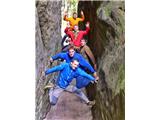
SMAR in Czech Republic, photo Marko Prezelj
Leader: Marko Prezelj (AO PD Kamnik).
Expedition members:
- Luka Stražar (Academic Alpine Section),
- Nejc Marčič (AO PD Radovljica),
- Luka Krajnc (AO PD Celje - Matica),
- Luka Lindič (AO PD Celje - Matica),
- Tadej Krišelj (AO PD Kamnik),
- Klemen Žumer (AO PD Radovljica),
- doctor: dr. Miha Gašperin (AO PD Radovljica).
We talked about the expedition, members, preparations, selected goal, acclimatization ascents etc. with Luka Stražar, expedition member, otherwise a member of the Academic Alpine Section, who together with Nejc Marčič received the alpinist Oscar golden ice axe in 2012 for the 2011 ascent (Dreamers of Golden Caves).
The main goal is an ascent along a new route on Phola Gangchen or Molamenqing (7661 m), which lies on the eastern edge of the Shisapangme massif.
The most impressive is certainly the southeast face of Phola (note. Abbreviation for Phola Gangchen). Of course, several factors must align for a successful ascent. The face is extremely steep in its central part. The summit part runs along the ridge, where significant exposure to wind from the Tibetan plateau can be expected.
More about the choice of peak and face was said by leader Marko Prezelj, top alpinist, recipient of two golden ice axes, also mentor or selector of SMAR: "I saw Phola Gangchen up close in 1989, when on the approach to base camp under the south face of Shishapangme we got lost and ended up in base camp under the east face of Shishapangme. At that time, the SE face seemed attractive to me, but I really remembered it only last year when we were looking for a suitable goal for the SMAR action. The additional attraction of the area is the fact that there are many different goals around the base camp, which we can choose depending on the conditions."
If conditions do not allow fulfillment of goals, do you have reserve goals?
The area is interesting not only because of one line, there are quite a few options.
How will acclimatization proceed?
Acclimatization is planned similarly to previous expeditions, with ascents on lower surrounding peaks, combined with scouting conditions in selected higher faces.
Among the ascents, Ice Tooth (6200 m), Nyanang Ri (7071 m), Pungpa Ri (7445 m) are planned for acclimatization, but when choosing more demanding routes, they also represent very interesting additional/reserve goals.
Why did you choose this goal/range, face, peak? Why do you consider the goal interesting?
We chose the area because it may not be one of the most famous and crowded, but it offers many very good goals. The area, due to its proximity to the eight-thousander, has received very little attention and has thus preserved many of its otherwise demanding climbing goals untouched. These offer many opportunities for original and very high-quality ascents.
What is this area like where you are heading - description of expedition progress, base, altitudes etc.
The area lies very close to the eight-thousander Shishapangme (8027 m). This fact is probably also thanks for the area not having experienced greater interest in the past. The expedition is planned as all modern expeditions aiming for alpine style climbing. We have about 30 base days planned, i.e. days available for acclimatization, rest and ascents in difficult routes.
Previous experience of the leader and expedition members.
In addition to Marko Prezelj, who has many expeditions behind him (he was on his first expedition when none of us were climbing yet), some members have experience from expeditions to the Himalayas, some are going on such an expedition for the first time. So we are betting on complementing experiences and youthful drive.
Leader Marko Prezelj (AO PD Kamnik), top alpinist and recipient of two golden ice axes, started seriously with alpinism in 1982 and was on his first expedition in spring 1987 (Lhotse Shar), where he thoroughly tested himself. They spent two months in base camp and reached a little over 7300 meters. Since then, he has been an active "expeditioner" and world-recognized top alpinist with notable ascents at home (recently with alpinist Tomaž Jakofčič he pulled a new route (Kaveljc) in the Triglav North Face) and around the world. Among the major successes of expedition members, Luka Stražar (Academic Alpine Section) and Nejc Marčič (AO PD Radovljica) certainly stand out, who in 2011 on the K7 West expedition (leader Urban Novak) climbed a new, first ascent route Dreamers of Golden Caves and received the golden ice axe 2012; in 2012 on the Janak 2012 expedition (leader Miha Habjan) they climbed a new, first ascent route Blue Racer.
How did you prepare for this expedition?
There were no major peculiarities here either. A large part of the preparation was done by each member individually, and within the preparations, ascents were also made on SMAR actions.
More about: SMAR - Slovenian youth alpine national team - was established in spring 2012, the idea has been present for more than three years. With the SMAR project, PZS embarked on a new path with a new approach to supporting young promising alpinists. In 2012, they carried out 5 joint actions >>>> report 2012.
This year's joint actions of the Slovenian youth alpine national team have been 3 so far (plus a weekend for promising alpinists), namely in the Julians, where they hosted promising young Japanese alpinists; in the Czech Republic, where they gained experience climbing sandstone; and in France, in the Dauphine area, which geographically concludes the chain of mountains around Chamonix.
We wish the leader and members of the expedition luck and safety on all paths and ascents!