Descriptions of difficulty levels
|
| Rok11. 09. 2008 22:20:00 |
Continuation of the topic on difficulty levels of climbing routes and protected paths (ferrata).
|
|
|
|
| sonce39. 09. 2008 00:00:00 |
Triglavski, I really enjoy reading your replies, you've already helped me with your answers. But I was unpleasantly surprised by your comment "where do you climb though". I think on the path over Prag you have to climb a bit, right?
No hard feelings and best regards! 
|
|
|
|
| triglavski9. 09. 2008 00:00:00 |
We climb usually in natural rock, artificial wall, icefall... We know alpinists, sport and free climbers. For better understanding of climbing, a bit about:
A climbing route is a virtually defined band in the wall where the climber ascends. Sometimes it's only a few meters high, usually half a rope length, but can be more pitches. Routes are secured with protection bolts (svedrovci), which serve for belaying and also show the approximate route line. At the top of the route there's an anchor for descent.
Protection bolts and anchor are usually placed by the climber-equipper of the route, who then first ascends it, names it and suggests the difficulty grade. Equipped but unclimbed routes we call 'project'. Such a route is usually marked with a red ribbon in the first svedrovci and we don't try to climb it without permission of the equipper.
The real grade of the route forms when over time more climbers repeat it and suggest their opinion on difficulty.
For grading there are several difficulty scales that developed in different countries. In the past we mostly used UIAA scale, lately we adopted the French way of grading routes.
On equipped, marked and protected paths we still walk, sometimes we do have to use hands on harder spots to overcome difficult sections easier, but that's not climbing.
| (+1) |  | |
|
|
|
|
| Klin10. 09. 2008 00:00:00 |
Triglavski, I don't agree with your answer.
What is grade 1 climbing? Using hands to assist while walking, right. So if there are bolts and you use them-you're climbing.
| (+1) | | |
|
|
|
|
| sonce311. 09. 2008 00:00:00 |
Klin, I agree with you. I interpret grade 1 climbing the same way.
|
|
|
|
| triglavski11. 09. 2008 00:00:00 |
Klin and sonce3, I don't agree with you, read a bit at least what the first 3 grades cover before you form opinions. A protected path is just a protected path, I've seen some crawling on it even on all fours.
I. Ascent goes through very rugged rocky terrain with plenty of footholds and handholds. Hands are used mainly for balance. Some passages can be exposed, so these ascents are not for the vertiginous.
Simplest form of rock climbing, hands used only for balance.
II. Here real climbing starts. Wall is quite steep, holds and steps smaller but plentiful. Rope belay is essential for non-climber hiker, especially if sections longer and more exposed.
This climbing already requires the three points of contact rule.
III. Climbing on very steep or even vertical wall. Rope belay mandatory.
Intermediate protection recommended on exposed spots, vertical sections or overhangs already require arm strength.
| (+1) | | |
|
|
|
|
| triglavski11. 09. 2008 00:00:00 |
And a bit more on grading of ferratas or protected paths:
GRADING:
A – EASY
Path: easy, more challenging parts well protected.
Terrain: reliable holds and steps. Less steep, climbing mostly possible without protection.
Protection: steel cables, ladders, bridges, bolts; steps allowing safe step.
B – MODERATELY DEMANDING
Path: easy to moderately demanding. Exposed parts well protected.
Terrain: reliable holds and steps. Alternating easier and harder sections. Rest possible.
Protection: steel cables, ladders, bridges, bolts; steps allowing safe step but requiring more caution.
C – DEMANDING
Path: high mountain. Requires surefootedness and sense of orientation.
Terrain: steep, exposed and vertical parts. Holds and steps small. Harder sections frequent.
Protection: steel cables, ladders, bridges, bolts and steps. Strength and courage needed for progress.
D – VERY DEMANDING
Path: high mountain. Requires surefootedness and sense of orientation. Intermediate parts of easier climbing without protection possible.
Terrain: precipitous, exposed and overhanging parts. Harder sections frequent.
Only for experienced mountaineers!
Protection: steel cables, ladders, bridges, bolts and steps. Strength and courage needed. Even hardest sections often protected only by cable.
E – EXTREME
Path: high mountain. Requires surefootedness and sense of orientation. Intermediate parts of easier climbing without protection possible.
Terrain: precipitous, exposed and overhanging parts. Harder sections frequent.
Only for very experienced and trained mountaineers!
Protection: almost exclusively steel cable, other protections only occasionally. Little possibility for early retreat.
|
|
|
|
| ania11. 09. 2008 00:00:00 |
well now, based on your experience Mr. triglavski, can you write examples of ferratas for each difficulty level separately. 
thanks!!!
|
|
|
|
| triglavski11. 09. 2008 00:00:00 |
Dear ania, take 5 days off and we'll go to each one separately, maybe start at Cellon, it has sections from A to D, and helmet needed, then jump to the new one at Säuleck which has E sections too and I was there just 14 days ago.
|
|
|
|
| Kriška12. 09. 2008 07:55:17 |
Quote: Triglavski, 11.9.:
"And a bit more about rating ferratas or protected paths:
RATING:
A – EASY
Path: easy, more challenging parts are well protected.
Terrain: reliable holds and steps. Less steep, climbing mostly possible without
protection.
Protection: steel cables, ladders, bridges, pegs; steps that allow safe stepping."
As I see, it also involves CLIMBING, as you yourself wrote. So why did you contradict previous comments that also talked about climbing on the path over Prag?
|
|
|
|
| panda12. 09. 2008 08:50:12 |
I don't understand something: if it's exposed, precipitous and unprotected - then you climb, otherwise not or what? Don't bullshit.
As soon as we climb up rocks and therefore need hand assistance, or use pegs and steel cables, it's a lighter form of scrambling. Then it just escalates depending on verticality: climbing, self-belayed climbing etc...
| (+1) | | |
|
|
|
|
| pepo21. 09. 2008 18:35:55 |
Obviously some "pedants" from the PZS forum have started migrating to this forum. I hope that one day "Filip" won't appear and start nitpicking every comma 
|
|
|
|
| sebanakis21. 09. 2008 19:25:48 |
I agree with triglavski. Climbing is divided differently. Here we get to the top with the help of steel cables and pegs. It's true that we use hands, but it's still not that real climbing used in crags, alpinism, ice climbing. There are no cables, just a route you want to climb and an anchor at the end for safe descent.
| (+1) | | |
|
|
|
|
| NEIC00821. 09. 2008 20:03:26 |
Steel cables or pegs are not important, because pegs for example replace rocks where grip is possible therefore climbing is climbing regardless of whether it is done with the help of pegs or steel cables or without. Of course a protected climbing route is significantly easier.
| (+1) | | |
|
|
|
|
| Jany22. 09. 2008 12:31:10 |
TRIGLAVSKI, you described the ferrata ratings from A to E very nicely. I'm still learning, so please provide illustrations of the descriptions of each level with at least one or two examples.
E.g. Where do you place Tominškova path on Triglav, or on Rinke over Križ and Kopinškova on Ojstrica. I'm interested.
Good luck!
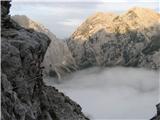 1 1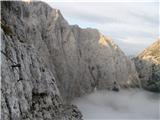 2 2
|
|
|
|
| geppo22. 09. 2008 13:04:03 |
joc001
I know the path to Križ and Kopinškovo well. If I look at >triglavski<'s description (ferrata rating - or rather protected hiking paths) I would rate them
both as A
occasionally some section of the path is B
Regards
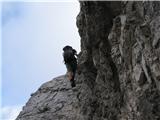 1 1
|
|
|
|
| geppo22. 09. 2008 13:45:48 |
I'm curious how others will rate these two paths. Maybe I rated a bit too quickly that the larger part of the path is A!!
So I correct to A/B larger part of the path.
I wouldn't rate any path section C!
Regards
|
|
|
|
| triglavski22. 09. 2008 17:56:53 |
In Slovenian mountains the Slovenian Hiking Trails Act applies, where in paragraph 1, article 8 it states: "Hiking trails are categorized into three groups according to technical difficulty: easy, demanding and very demanding hiking trails. In information material on hiking trails, guidebooks and on tourist information boards and maps where hiking trails are marked, their category must also be indicated." The ferrata rating descriptions, I think we know where those paths are, I didn't invent them myself, you can find them and familiarize yourself with them in detail here: http://lea.hamradio.si/~s51kq/photo_album/Climbing_and_Mountaineering/pdf_climbing/Via_FERRATA.pdf
|
|
|
|
| geppo22. 09. 2008 18:16:05 |
|
|
|
You must log in to post a comment:
If you do not yet have a username, you must first
register.