Gschnitz - Habicht (normal path past Innsbrucker Hütte (Gschnitz))
Starting point: Gschnitz (1242 m)
| Latitude/Longitude: | 47,04252°N 11,34538°E |
| |
Route name: normal path past Innsbrucker Hütte (Gschnitz)
Walking time: 5 h 30 min
Difficulty: very difficult marked way
Elevation gain: 2035 m
Elevation difference along the route: 2035 m
Map: Brennerberge, 31/3 1:25.000; Outdooractive Stubai Wanderkarte
Recommended equipment (summer): helmet
Recommended equipment (winter): helmet, ice axe, crampons
Views: 654
 | 3 people like this post |
Access to starting point:
From Ljubljana, we drive on the highway past Salzburg in the direction towards Munich. At the multilevel junction Dreieck Inntal, we turn onto the road A93 in the direction of Innsbruck/Kufstein/Brenner. Upon returning to Austria, we continue to the junction with the exit Innsbruck-Mitte. Here we don't turn towards Innsbruck, but continue on the highway A13 in the direction towards the Brenner Pass. We continue on the highway all the way to the settlement Matrei am Brenner, where we take exit 19-Matrei. We continue driving on the road B182 to the settlement Steinach am Brenner, where at the roundabout in the middle of the town we take the first exit and in a gentle ascent continue driving past Trins through the scenic Gschnitztal valley to the eponymous elongated village, where soon after the church we will notice a relatively small free parking lot intended for visitors of Innsbrucker Hütte.
Alternatively, we can drive through northern Italy: in this case from central Slovenia on the highway A2 we drive to one of the border crossings with Austria and continue towards Lienz. Here we continue on road 100 and past the Prato alla Drava pass we drive into Italy. In Italy we follow road SS49 all the way to the junction with highway A22 in the direction towards the Brenner Pass. After the pass, we continue in the direction towards Innsbruck, but only to the exit onto road B182 near Brennersee. On this road we continue to Steinach am Brenner, from there following the instructions described above.
Route description:
From the parking lot, we head onto a clearly visible and marked path, initially fenced, in the direction of Innsbrucker Hütte, which soon begins to ascend moderately along the edge of cultivated land. Above the village, a narrower path continues through thinner forest, which occasionally offers nice views of the scenic Gschnitztal valley. For some time we moderately ascend along the path zigzagging into the steep slopes of the Habicht group range. A little higher, with increasingly beautiful views on the southern part of the Stubai Alps, where Pflerscher and Gschnitzer Tribulaun stand out especially, we enter the open world of high-alpine meadows. Locally somewhat precipitous path high above the valley in a wide arc below the walls of the Habicht group peaks crosses towards the west. While doing so, we cross a few gullies, where a somewhat more cautious step is required. In the last part of the path to the hut, the trail ascends somewhat more steeply again to the grassy edge, behind which we step into the high-alpine world between the walls of Habicht and Kalkwand, where we first spot Innsbrucker Hütte. Below the western edge of the Kalkwand massif walls, with the aid of some fixed protections, we descend slightly to the transverse path between the aforementioned massifs, where paths from the Feuerstein inn and from Stubaital gradually join us. From here, it is only a few dozen steps to the hut.
From Gschnitz to Innsbrucker Hütte is about 2h30-3h. The path is not particularly demanding, but quite steep and locally somewhat precipitous, and in winter very exposed to snow avalanches. The approach from the Feuerstein inn is slightly shorter and easier, but somewhat less scenic.
Behind the hut, we continue on a winding trail across the high-alpine meadow, which soon transitions into relatively gentle scree of Habicht's side spur. Along the well-marked path across flat rocks, we ascend to a large cairn, from where the continuation of the path across Habicht's wide ridge is clearly visible, and a view also opens to the attractive high-alpine lake Alfaier below us. We descend slightly to Habicht's main structure and ascend moderately steeply to the fixed protections, which assist in crossing the sharp rocks of the mountain's western flank (demanding). After approx. 10 minutes of walking on the secured path, we find ourselves above the edge of a high-alpine basin into which steep gullies fall. After a shorter gentler ascent, with the aid of a steel cable we ascend across flat rocky terrain to Habicht's short side ridge, across which with nice views towards the hut, the northern and eastern parts of the Stubai Alps, and the Zillertal Alps we approach the summit structure of the Habicht massif.
Continuing, we follow the path across the rugged rocky rib of Habicht, where we occasionally need to use our hands as well. A moderately steep ascent brings us after less than half an hour to a large plateau below the summit, where we step onto the last remnants of Habicht's glacier. Snow cannot be avoided here even in high summer, but crossing the snowfield is relatively straightforward; due to the path's popularity, a clear track will always guide us in the high-alpine season, and winter gear is then usually not required.
Above the glacier, we follow the path through high-alpine rocky terrain, which in a gentle ascent crosses westwards towards the clearly visible summit cross. A little below the summit, we reach occasionally unpleasantly loose steel cables, which will assist in the final section. With their help, we first cross exposed above the precipitous slopes below the summit, then steeply ascend to the large cross on the spacious summit, which rewards the ascent with an exceptional panorama.
Due to its relatively low difficulty, majesty, and wonderful view, Habicht is among the most popular Tyrolean three-thousanders. The ascent along the normal route past Innsbrucker Hütte is near the lower limit of very demanding paths (technically, it might even be classified as "merely" demanding), although located in the still glacier-intensive Stubai Alps, it usually requires no additional equipment, while Innsbrucker Hütte offers a comfortable overnight option roughly halfway to the summit. Nevertheless, the ascent should not be underestimated: regardless of the starting point for Habicht, more than two thousand meters of elevation await, and the paths are locally precipitous. Although feasible in one day, I recommend a two-day trip with possible visit to lake Alfaier and the educational via ferrata near the hut or ascents to nearby Kalkwand or Ilmspitze.
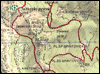
Along the route: Innsbrucker Hütte (2369m)
Photos:
 1
1 2
2 3
3 4
4 5
5 6
6 7
7 8
8 9
9 10
10 11
11 12
12 13
13 14
14 15
15 16
16 17
17 18
18 19
19 20
20 21
21 22
22 23
23 24
24 25
25 26
26 27
27 28
28 29
29 30
30 31
31 32
32 33
33 34
34 35
35 36
36 37
37 38
38 39
39 40
40 41
41 42
42 43
43 44
44 45
45 46
46 47
47 48
48 49
49 50
50 51
51 52
52 53
53 54
54 55
55 56
56 57
57 58
58 59
59 60
60 61
61 62
62
Discussion about the trip Gschnitz - Habicht (normal path past Innsbrucker Hütte (Gschnitz))
To post a comment you must log in:
If you do not yet have a username, you must first
register.