| jerque26. 02. 2026 18:33:57 |
Yesterday for the first time in the Glinščica valley  . On the "Italian" side, because on the Slovenian side apparently movement restrictions apply until the completion of the second track, and with the current Italian understanding of Schengen, one can't be completely sure how legal it is to cross the border on some goat paths. What to say, the canyon is truly magnificent, it could be "sold" to many followers as alpine . On the "Italian" side, because on the Slovenian side apparently movement restrictions apply until the completion of the second track, and with the current Italian understanding of Schengen, one can't be completely sure how legal it is to cross the border on some goat paths. What to say, the canyon is truly magnificent, it could be "sold" to many followers as alpine  , for those of us who aren't exactly snow lovers, it's a pretty good winter option for testing fitness and refreshing technique on somewhat more demanding terrain. The entire canyon area lies on Slovenian ethnic territory (and even with various signs, bilingualism seems to work), so I think it's quite right to consistently use Slovenian names and perhaps only mention the Italian one at first mention for easier orientation on international maps. , for those of us who aren't exactly snow lovers, it's a pretty good winter option for testing fitness and refreshing technique on somewhat more demanding terrain. The entire canyon area lies on Slovenian ethnic territory (and even with various signs, bilingualism seems to work), so I think it's quite right to consistently use Slovenian names and perhaps only mention the Italian one at first mention for easier orientation on international maps.
The favorite paths seem to be the walking path from the Premuda hut in Gornji Konec (it. Bagnoli Superiore) or Boljunec (it. Bagnoli della Rosandra) towards Botač (it. Bottazzo), where it seems it could even be done in "city" shoes, and the cycling-walking path along the route of the former railway line from Trieste to Kozina, which climbs the northern slope of the canyon (the ascent is apparently up to about 32 per mille), just before the border it makes an S bend past Draga and then enters Slovenia. This path is named after the Triestine cyclist Giordano Cottur, who achieved some nice successes on the Giro in the period just before and after WWII, at two places where I saw it, there's very nice macadam (so probably doable with a "road bike" too), there was quite a bit of traffic for a workday, but everyone without exception was riding slowly enough, so probably no "close encounters" with "pedestrians". There are also a few tunnels on the route, but they are all short enough that we really don't need a light during the day.
For those from the coastal region, the most suitable entry point is probably Boljunec or Gornji Konec (apparently the parking regime there is very complicated and depends on "holidays", which by Italian law include all Sundays), for those from other parts of Slovenia, it's most convenient to leave the Primorska motorway at Kozina, drive through the border crossing at Krvavi Potok (obviously, there's no real control there, the Italian policeman waves nicely to all non-suspicious to continue), at the first serious junction turn left towards Jezero (it. San Lorenzo) and immediately after the narrowest section of the road through the village on the left we see a parking lot at the viewpoint itself, which also allows the disabled and less mobile to get some impression of the canyon. A little further on the left there's another gravel parking lot near another viewpoint. Of course, both are free and without time limits for parking, in the middle of the workday there were only a symbolic number of cars at both combined, roughly balanced between Italian and Slovenian plates, a few more vehicles with Italian plates were parked next to the village church upon departure, where it's obviously not prohibited.
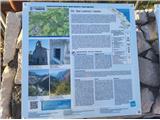
Any hiking map shows that there are plenty of official and otherwise marked paths in this area, which is really impossible to cover all in one go. For someone who's there for the first time and interested in views for possible future visits as well as suitable photo spots and at least some cultural heritage, the most representative route seemed to me from the church of St. Lawrence along the northern edge past the Stena cliff (the Italians didn't even "translate" it but added Monte in front), descent to the cycling path and then to Botač, then along the "walking path" towards Premuda and along the way with side paths to the Supet waterfall (according to some Italian sources, Cascata di Val Rosandra) and the church of St. Mary on the Rocks (it. Santa Maria in Siaris), then just before "Premuda" a branch to the ascent to Muhov grad (it. Castello di Moccò) and then past Hrvati (it. Hervati) along the nearest unmarked path to the viewpoint at Jezero.
Already on the technically easier section along the edge to Stena, the decision for proper hiking boots proved correct, later of course even more so. But the northern edge is somewhat higher than the southern, so besides Trieste and Milje we can get a good look at the canyon itself and the opposite side, especially the ridge where Cippo Comici is also noticeable (does the ridge have a name?), on its steep slope Mary on the Rocks really invites us to test telephoto lenses.
Somewhere on Stena the warm-up part of the "walk" ends and the descent follows, first to "Cottur", where we notice signs that it's routed right along the border. Looking for suitable viewpoints, I take a short walk along the path. And of course I run into goats, maybe even the same ones that thoroughly licked my car on Socerb a few weeks ago. And right on the section where a multilingual sign warns of falling rocks and wild animals, with a goat drawn. From a suitable spot, I view Tabor above Botač on the Slovenian side of the border from afar, but it looks like there are just some walls and everything around is obviously overgrown, so I don't risk possible "illegal" border crossings and skip it. More out of curiosity, I quickly go to the "wine cave", which also lies on Slovenian territory, judging by the predominant English (and no Italian at all), someone is counting mainly on tourists from so-called "third countries".
Then to the rest area, where a path branches off descending to Botač, which shows that despite its remote location there's still some life there. Interestingly, when I was walking around Osp, Socerb etc. a while ago, I noticed quite a few monolingual signs "proprietà privata" or "attenti al cane", but in Botač right on the Italian side of the border at one house a monolingual sign "beware of the dog", someone else bought an Italian mailbox with "posta" and hand-drew a roof over the S... The first bridge in the village itself leads to the Slovenian side of the border, as we are immediately greeted by a "fence" in the colors of our tricolor, next to it a small house that was probably once a guard post or border crossing. Our path then goes a few meters along the road until a new path branches left past ruins, probably a mill, over a bridge above the confluence of Grižnik and Glinščica, then that mentioned "walking path" to "Premuda". If until now I haven't met a living soul (not counting cyclists and a few runners on "Cottur"), now it's different, as I meet more and more coming from the opposite direction... it's harder to call them all hikers, many look more like walkers or companions of four-legged pets, because with my classic hiking gear I seem somehow exotic. Interestingly, surprisingly many respond to my bilingual greeting in Slovenian. But in order. When the path reaches the scree, if we look around a bit instead of at screens, we notice the Supet waterfall. And as if on cue, a poorly made "path" branches downward; before it becomes too steep, with a little care (and of course proper footwear) we can reach a point where the waterfall is offered to us on a plate.
Upon returning to the path, soon an unmarked branch left towards Mary on the Rocks. Uff, this eastern approach is quite steep and technical, with us it would definitely already have a "fixed rope". But with the right footwear, it's not too big a deal. At the locked church there are some rocks that invite rest, birdwatching and possibly a snack. Contrary to expectations, the waterfall isn't visible from there, actually only the upper part is, the rest is obscured by a cliff. Fortunately, the western and also marked approach to the church is much less technical and more zigzag. Upon returning to the main path, I find another short and "trodden" branch downward, from where we get an even more telephoto view of the entire waterfall. But when I return to the path and pass the branch to the church, there's... a somewhat scratched and sticker-covered sign, but still clearly prohibiting approaching the waterfall. So I've unknowingly committed an offense at least twice, because there was definitely no such sign from the other side. Who knows, maybe the path maintainers think that those who came to Botač via other paths are well-equipped and experienced enough to judge for themselves how far they can go...
Back on the "highway" towards "Premuda". With one eye I somewhat worriedly look at two houses high on the slope, which I know belong to Jezero (which we'll have to reach anyway), with the other at another steep "little hill", which I'm already sure is Muhov grad. Meanwhile, the path approaches Glinščica and soon after a small rest area the map tells me to branch off. First across Glinščica. No bridge, but at normal water level you step into the shallower part of the river (and in practice test the manufacturer's claims about waterproofness of the footwear ), from where you can step onto a rock on the other bank. Then just steeply uphill on a poorly trodden path on the bare slope (not recommended in summer heat), in the last part even on smooth rock. With proper soles it goes, but on wet I wouldn't dare anyway. The effort is rewarded with an official semicircular viewpoint, from where we have Gornji Konec and Boljunec like on a plate, not to mention the canyon. From here a nice gentle path would take me near Zabrežec (it. Moccò), but I take the poorly trodden path right to the top... to find that only one wall remains of the castle among the trees. I descend towards Zabrežec on an otherwise quite OK forest path, ignoring one fallen tree. Some official marked path would join "Cottur" somewhere "in the middle of nowhere", so with the map I find a more direct one that crosses "Cottur" in an underpass and reaches Hrvati. Just before the first house, a new branch to a path that the map calls "Biscottone Trail", which in a quite steep ascent somehow bypasses the wall and reaches the viewpoint at Jezero, architecturally the same as the one at Muhov grad. From here it's not far to the road and Jezero.
Anyway, the photos are mostly in "raw" state and would need further processing, which takes time.
 1 1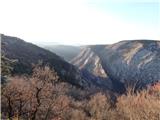 2 2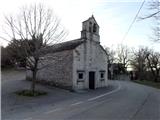 3 3 4 4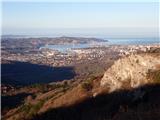 5 5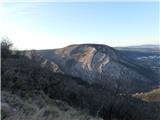 6 6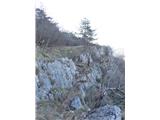 7 7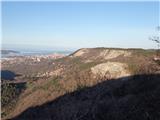 8 8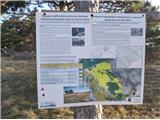 9 9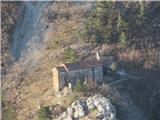 10 10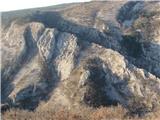 11 11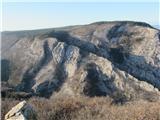 12 12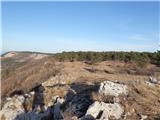 13 13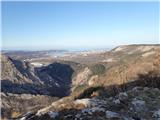 14 14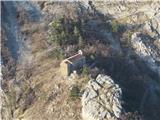 15 15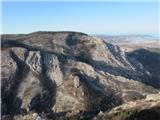 16 16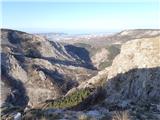 17 17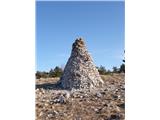 18 18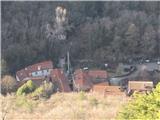 19 19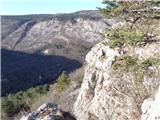 20 20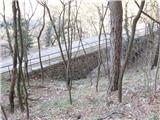 21 21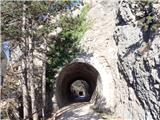 22 22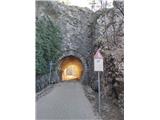 23 23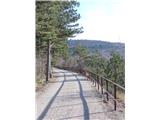 24 24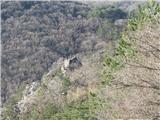 25 25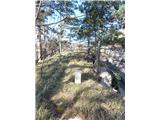 26 26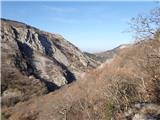 27 27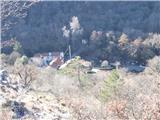 28 28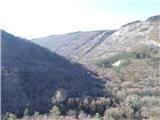 29 29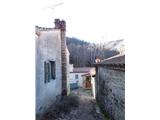 30 30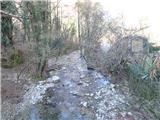 31 31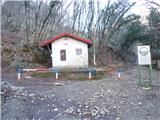 32 32 33 33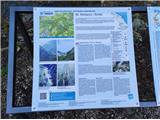 34 34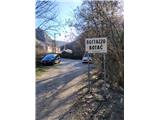 35 35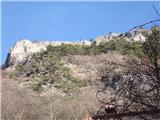 36 36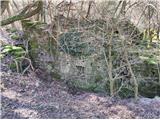 37 37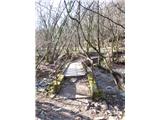 38 38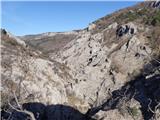 39 39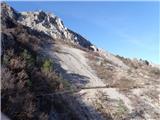 40 40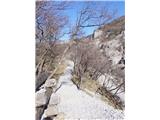 41 41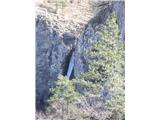 42 42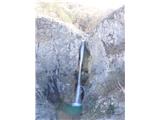 43 43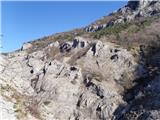 44 44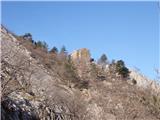 45 45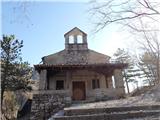 46 46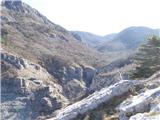 47 47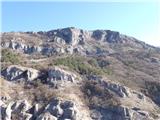 48 48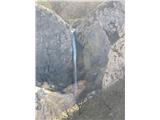 49 49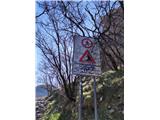 50 50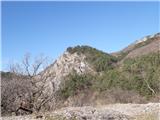 51 51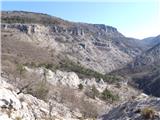 52 52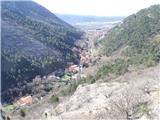 53 53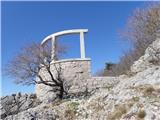 54 54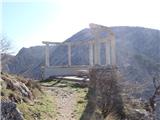 55 55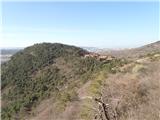 56 56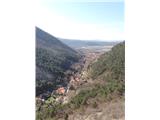 57 57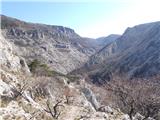 58 58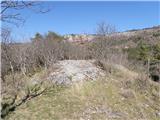 59 59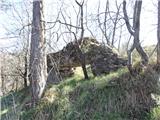 60 60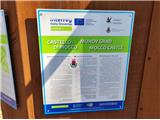 61 61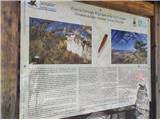 62 62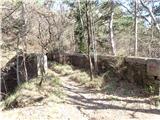 63 63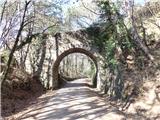 64 64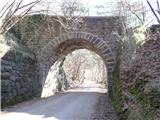 65 65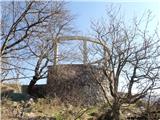 66 66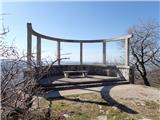 67 67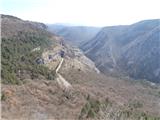 68 68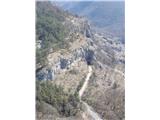 69 69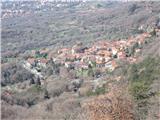 70 70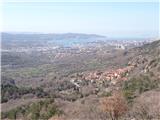 71 71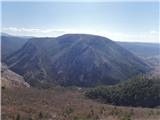 72 72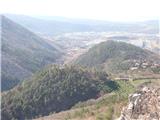 73 73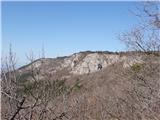 74 74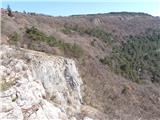 75 75 76 76
| (+7) |  | |
|
|