|
| otiv20. 07. 2014 08:32:23 |
Good morning!
You know me, Brane, and my "expertise" in recognizing flowers. For better recognition I always take more shots and as I see, I'll need even more 
Thanks and best regards to both!  
|
|
|
|
| Apolonija20. 07. 2014 10:06:14 |
Otiv, hairy or not hairy, that's the question now. You decided it's not. Judging by the picture it is, in my opinion it could be one or the other. The hairs are apparently so small they're hard to see with the naked eye. That's why I root for giving only genus name - hawkweed - without species. Otherwise we're not botanists, not taking an exam, just learning a bit and admiring a lot. Have a nice day.
|
|
|
|
| velkavrh20. 07. 2014 10:55:44 |
I also often use only genus name because I can't distinguish species either. Say with eyebrights, bellflowers, poppies, many yellows or cudweeds whose genus I can't determine. But we keep learning and discover something new. True, there's too much of everything and things get forgotten and mixed up. So at least we don't get bored.
|
|
|
|
| velkavrh20. 07. 2014 11:06:54 |
From the last trip I identified or they helped me identify glandular sandwort.
|
|
|
|
| Močerad21. 07. 2014 10:46:38 |
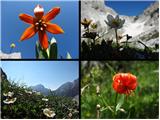
Along the path to Savinja Saddle..
 1 1
| (+2) |  | |
|
|
|
|
| otiv21. 07. 2014 12:14:35 |
@strelec1954, so that there will still be pics of rarely seen ones, I recommend that you avoid, of course if possible, photographing from above. As an example, you can take @Močerad's pics.
Best regards!
|
|
|
|
| Apolonija21. 07. 2014 20:51:38 |
strelec1954
Where did you hide the lady's slippers? I know you happily showed them to us, because you really don't stumble upon them very often. Otiv just wanted to help so the photos would be even more unique. I too often photograph from above, thinking that way I capture more little flowers together. They were visible in yours too, velesa, for example. True, photos "on knees" are more aesthetic and show the individual desired plant better. I still need to learn that. Come on, don't get mad and return the orchids, please. And post more often so the crowd is more colorful.
| (+3) | | |
|
|
|
|
| velkavrh22. 07. 2014 14:31:32 |
Skipping ahead:
No.2-germander speedwell
No.3-oxlip-I see you know it
No.4-cranesbill-that too-species differ by leaves.
No.6.7.8-Turk's cap lily-you know
No.5,23,34-Austrian or rosy silene, possible mix-up with hairy catchfly
No.9,10-whorled clary
No.11-headed knapweed-you know
No.12-smooth yellow-rattle-possible mix-up with hairy yellow-rattle.
No.13-probably just common St. John's wort
No.14-nettle-leaved bellflower-one of the tall ones-recognized by characteristic leaves
No.15.16,21-common spotted orchid
No.40-common cow-wheat-you know-same pic as No.1-next to it is an unbloomed lady's slipper-hard identification
|
|
|
|
| Apolonija22. 07. 2014 14:38:14 |
dleskovec, hi!
Quickly, as I'm heading out:
1- angelica - wood angelica
2-such flower has germander speedwell
3- oxlip, common spotted orchid
4- Hungarian cranesbill, also on 22
5- pink-red silene, yours more pink, also on 23 and 34
6, 7, 8- Turk's cap lily in foreground
9, 10- whorled clary
11- headed knapweed
12- flower of smooth yellow-rattle
13- St. John's wort
14-not clustered, but nettle-leaved bellflower (petals have hairs!)
last pic is same as first
You named many yourself, bravo! Regards
|
|
|
|
| Apolonija22. 07. 2014 14:45:35 |
I see Brane and I wrote simultaneously and since we both "diagnosed" the same, it must hold
I agree that the lady's slipper is hard to identify reliably. From leaves and inflorescence shape I assume it's angelica.
The yellow-rattle is very likely smooth, since hairy is rare. Field cranesbill has divided leaves.....
|
|
|
|
| dleskovec22. 07. 2014 20:31:24 |
Apolonija and Brane; thanks for the help;
when I see the blooming flower,
heart and soul tremble;
so good night to you too!
|
|
|
|
| Apolonija27. 07. 2014 21:51:14 |
primrose. Geum coccineum grows in mountainous areas of the Balkans, in Slovenian - garden avens. Regards
| (+1) | | |
|
|
|
|
| Apolonija27. 07. 2014 23:12:01 |
otiv, how many flowers did you shoot on Grmada!
Do you remember what the basal leaves of the plant on pics 1, 2, 3 look like? Such an inflorescence has long-leaved lousewort.
7, 8 common calamint
11 fruits most likely belong to lovage.
12, 13 - horse mane
14, 15 - see 7, 8
16 not tufted bellflower
23 common mezereon
25, 30 - it seems to me that there are several flowers on one stem, which means it is Montpellier pink. If I'm wrong, correct me.
32, 33, 34 - white deadnettle
Have fun
| (+1) | | |
|
|
|
|
| francimedved27. 07. 2014 23:34:32 |
I found this in the mountains (Košuta), it grows at around 1500 m altitude and is almost two meters tall, does anyone know it?
|
|
|
|
| Apolonija28. 07. 2014 01:37:10 |
Franci, it is good to know it, less good to eat its black cherries. This is (poisonous!) wolf cherry.
| (+1) | | |
|
|
|
|
| otiv28. 07. 2014 07:11:39 |
Apolonija, thanks for the nice wishes and flower names. Today I'll sort everything out, since there won't be nice weather.
Walk around your flowers,
which adorn the home paths.
I know that this world is dear to you,
on it grows your dearest flower.
May it give you strength and joy,
fulfill all blooming wishes.
I browsed the internet a bit more, of course based on your names, and I can only congratulate you on your knowledge of vegetation. Now I know all the pinks too, thanks to you. That bellflowers give me trouble is clear as day. Maybe the day will come when I say, it wasn't all in vain, now I know.
Best regards!
|
|
|
You must log in to post a comment:
If you do not yet have a username, you must first
register.