|
| zlatica11. 09. 2014 12:33:48 |
Velkavrh, very interesting. First your flowers around Kamen Castle, and second around the saxifrage. I didn't know about Host's saxifrage; judging by the flowers, I haven't noticed it in nature either, because the flower is so typical that I would remember it. Regarding my flower, which I looked at in great magnification on the photo, I found out that the dots are brown, which shows the flower is slowly "fading" and not pink dots, so it doesn't go towards Host's saxifrage. Regarding the rosette, yes, that's still open. Under magnification, you can already see the strong characteristic silver edges on the leaves, typical for crusty. Do you perhaps remember where you found Host's saxifrage? Anyway, thanks for the hint, because from now on I'll be more attentive to the differences. And of course for the monkshood. In Flora Alp. it is shown, but not in such bright variegated color as mine, so I didn't think of it. Otherwise the handbooks are great. Thanks for the info! Eternally grateful...lp 
|
|
|
|
| Apolonija11. 09. 2014 12:58:35 |
Is it actually called Host's or crusty? In nature there's no dilemma for me. Above all, Host's is much larger, rosettes are really big and flower stem high.
As for the monkshood, I wavered between variegated, as I hinted, and narrow-leaved. I didn't decide for variegated because it should have a high helmet. But the color and panicle shape speak for it. I'm still in doubt.
|
|
|
|
| velkavrh11. 09. 2014 13:30:45 |
The crusty saxifrage from Host's is easiest to distinguish by the rosette leaves. The leaves excrete the most lime of all saxifrages, so rosette leaves are almost gray-silver, while Host's leaves are green. Host's leaves also excrete lime on the edges of the leaves but much less than crusty. On the leaf edges there are like little drops - dots - of this lime (in crusty these lime dots are significantly larger and more visible). But crusty is similar in growth to Host's. On the branched stem it's full of flowers. Host's is significantly taller in stem growth than crusty. Height according to literature - Host's 30-60 cm, crusty 20-30 cm.
On Planina Ovčarija grows Host's saxifrage exactly along that rock face right of the marked path junction - under that rock the path turns over Štapce. It also grows above the path from Studorski preval towards Vodnikov dom. I always find it on the botanical path - Črna prst, where there's a sign at the site and also in many other places like Julijci and KSA. In Karavanke I think I haven't noticed it yet.
Finally I cleared up the dilemma about the beautiful saxifrage, which really doesn't grow here. On the path to Kozjek and along the valley of Reka river (tributary of Kokra) grows confirmed changed saxifrage, which is really similar in growth to the beautiful one.
|
|
|
|
| zlatica11. 09. 2014 14:00:59 |
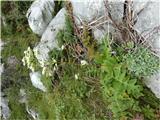
As a supplement, the upper saxifrage (that one or those) I photographed a few turns before Planina Ovčarija, if you go there from Planina Viševnik. But it was much taller than usual, so I couldn't photograph it up close all at once, only from afar. So I'd say by "finger" estimate it was about 0.5 meter high, which pulls towards Host's. But I don't understand why it didn't have dots on the flowers then. I'm attaching this photo from farther away, unfortunately sideways. greetings
 1 1
|
|
|
|
| velkavrh11. 09. 2014 16:18:55 |
zlatica, it is Host's. As I already wrote we have two subspecies of this saxifrage. One has no dots, or they are poorly visible. Both grow sometimes very close to each other.
|
|
|
|
| zlatica11. 09. 2014 17:01:41 |
Bravo, we/you have identified it.. That makes me happy...
|
|
|
|
| zlatica12. 09. 2014 11:16:40 |
Oh, what a beautiful botanical collection! Very interesting and useful to review a certain type of flower in metamorphic forms like this. When there will be no flowers left in nature in winter, we'll be glad if you cheer us up again with presentations of individual flowers from your own collection. lp
|
|
|
|
| velkavrh13. 09. 2014 08:38:27 |
Bad weather doesn't hinder me too much on hikes, last year I went several times even in bad weather, but not into rocks. I'll go to Nared only in October, so now I have time to review the recorded material and ponder dubious identifications. Of course, if I'm too doubtful I send it to experts for identification.
| (+1) |  | |
|
|
|
|
| Apolonija13. 09. 2014 14:36:00 |
Hello, Velkavrh!
I admit that from your photos I can't distinguish one dryad from the other at all. All except 4 look the same to me. Lp
|
|
|
|
| velkavrh14. 09. 2014 09:23:12 |
The alpine dryad differs from the octopetalous one by the flower. Not by color, as it's somehow identical. In the alpine, the flower isn't so spread out and the perianth follows it well. In the octopetalous, the flower itself is always wide open, flowers are also larger. True, the leaves on the alpine are hairy on both sides, which isn't visible in the pictures. The alpine is also taller.
|
|
|
|
| Apolonija14. 09. 2014 12:49:54 |
I know those characteristics, but still from these photos alone it would be hard for me to conclude that, for example, 3 and 5 are octopetalous and not alpine. If the biologists said so, I believe it. Lp
|
|
|
|
| Tadej15. 09. 2014 08:18:42 |
Some pictures of little flowers from a trip to Lož castle.
| (+1) | | |
|
|
|
|
| Apolonija15. 09. 2014 08:34:03 |
Balfour's balsam
sticky sage
common yarrow
clustered bellflower
Nice sunny day, I wish!
| (+1) | | |
|
|
|
|
| Tadej15. 09. 2014 08:49:40 |
Thanks, I've added the names.
| (+1) | | |
|
|
|
|
| Tolminc17. 09. 2014 16:56:41 |
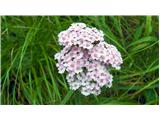
I'm curious what flower this is? Thanks for the answer
 1 1
|
|
|
|
| otiv17. 09. 2014 19:35:20 |
It looks similar to common yarrow, which can also be pink.
| (+1) | | |
|
|
|
|
| Tolminc18. 09. 2014 11:09:49 |
@otiv, could be yarrow. Thanks.
|
|
|
|
| otiv18. 09. 2014 16:33:33 |
Hello @zlatica!
Nice, really less and less flowers in the mountains. But yesterday I was surprised by more spring-like flowers during visit to Velika Planina.
In pic 16,17 and 18 it's fringed gentianella
25, it's loosestrife, but I don't dare claim which.
|
|
|
You must log in to post a comment:
If you do not yet have a username, you must first
register.