|
| zlatica2. 09. 2014 16:48:34 |
Wow, how much knowledge is hidden in your heads! I'm totally enthusiastic: one would just do that, look, compare pictures, study, but what, when there's still so much housework that's not all pleasant.
So, regarding the gentianella: I went to check another picture I have, and it seems the calyx leaves are more visible and they seem narrow to me and not bellied. I'm attaching this photo too, judge if possible by this.
Regarding the nigritella: the more I look, the more I see it's not Widder's, bicolour, yes that could be it. Attaching also one poorer picture, because no sharpness. Since I still don't know what the difference is from the moisture-loving nigritella, I stick with bicolour.
Yes, velkavrh, and also this: thanks for the pictures of gentian and nigritella. lp 
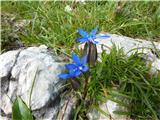 1 1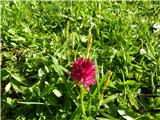 2 2
|
|
|
|
| velkavrh2. 09. 2014 18:47:04 |
I'm forwarding pictures of gentianellas.
|
|
|
|
| Apolonija2. 09. 2014 19:19:25 |
Thanks, Brane, for the good illustration.
Zlatica, the gentianella is really bellied, as Velkavrh determined.lp
|
|
|
|
| zlatica2. 09. 2014 19:40:22 |
Thanks to both. I'll note it under the picture. lp 
|
|
|
|
| velkavrh3. 09. 2014 07:57:04 |
zlatica, I also don't know the difference between bicolour and moisture-loving. I'll have to take the Flora Alpina handbooks from the library again. There are very illustrative pictures of all nigritellas of the alpine area. A friend who lives in Austria also sent me a nigritella that grows there, it should even be a border one. That's Nigritella nigra subsp. austriaca (black by us, although incorrect). I don't publish foreign pictures, I have them only in my private albums. Someone did post that he always finds moisture-loving between Bogatin and Lanževica and that they are surely moisture-loving. It would be worth going to check. This year due to abundant rain the growing season of mountain flowers has shifted at least by one month, so we can still find all sorts.
|
|
|
|
| velkavrh3. 09. 2014 08:05:18 |
And also this. I was notified, albeit a bit late, when I found a nice lady's slipper on Zelenica, I found also a nice yellow lousewort that I've never seen before. It's determined as Bosnian lousewort-Pedicularis hoermanniana. It's rare. It's very similar to the yellow lousewort that supposedly doesn't grow here, although Hoppe lists it also in our mountains. I need to check where Flora Alpina places these two louseworts.
|
|
|
|
| zlatica3. 09. 2014 08:26:14 |
Yes, I see, velkavrh, that the nigritella area is incredibly broad and full of interesting peculiarities. I'm only at letter B here.. But I'm interested in the mentioned handbook Flora Alpina, because last time I searched in Ljubljana for some handbook on alpine flowers also in foreign language, but there was nothing enjoyable. I have namely only Ravnik's handbook, and Alpine flowers by Hoppe and by Wolfgang Lippert. I'd be grateful for a hint where to get Flora Alpina, or who is the author. Is it in English? Or perhaps if there is some other literature... Regarding the lousewort, it is really something special, never seen in nature.
|
|
|
|
| velkavrh3. 09. 2014 12:07:19 |
I have it from Hoppe, from Lippert and Ravnik I've also borrowed it from the library. Actually I've brought everything possible from the library. Flora Alpina was published in Germany. These are three handbooks, two very thick, the third is some kind of collection. I occasionally borrow them from the library. They were also adapted for our market. Flowers that grow here have names translated into Slovenian. They are really quality. I've already asked for them in bookstores, but they are sold out. They were sinfully expensive. Apparently they can be got much cheaper in Austria and Germany-of course no translation.
|
|
|
|
| zlatica3. 09. 2014 14:46:02 |
Brane, thanks for the info. I'll look around a bit in libraries and publishers abroad. regards
|
|
|
|
| zlatica3. 09. 2014 15:02:46 |
ups.. already found it, Amazon has it for 112$. 4 authors, right? Given the price need to think a bit about purchase, haha. regards
|
|
|
|
| zlatica3. 09. 2014 17:56:24 |
Apolonija, I think not, because those are pounds, 1 GBP is approx 1.65$, which means the price of 86 pounds is 141 $, even if I take the variant for 69GBP, we're only about the same. Yeah, around 85€ of our currency for this trilogy, if I didn't mess up somewhere.
Really though, you need to browse different Amazons in different countries, because they usually have very different prices, then also include shipping costs, from where they are lowest.
|
|
|
|
| Zebdi4. 09. 2014 08:40:55 |
When ordering outside the EU you need to add shipping, customs and VAT. On bookdepository.co.uk they have it for 118€, shipping free. They ship from the EU, so no tax and customs. Maybe worth considering in this direction too...
EDIT:
On German eBay they sell for 95€ + 10€ shipping.
|
|
|
|
| Meto4. 09. 2014 09:16:49 |
On German Amazon they are at 95€, if we add shipping to that, it still comes cheaper than Bookdepository (+ that Amazon has much better packaging).
|
|
|
|
| zlatica4. 09. 2014 12:10:45 |
Well, more heads more knowledge, you really need to compare different sources and then decide for the most favorable option. It's also important here which foreign language you master. Slovenian technical terms are anyway missing in every case, so you never have everything.
|
|
|
|
| zlatica4. 09. 2014 13:48:46 |
Velkavrh, how nicely you've pampered us again with the little flowers..! I so understand that one can hardly stay inside all the time.
A week ago when I was up here, I didn't notice this thick-leaved thistle, nor the broomrape. Where does this flower fit and who are its relatives? Really interesting. And of course you found a very nice willowherb. Aren't there more species of them? This one is very nice, especially the single flower. Yes, we'll be more and more excited about every flower we find, as autumn comes with fast steps. Today I first noticed how leaves fall from trees when it just blew a little. Greeting
|
|
|
|
| velkavrh4. 09. 2014 14:19:23 |
Broomrapes -Orobanchaceae- are a separate genus. Latin name for broomrape is Orobanche. We have as many as 150 species. Only about ten grow with us. The most common are white, small, delicate, yellowish-white, scarlet and common. These are plants without their own chlorophyll, parasites. Mine is probably scarlet or common.
|
|
|
|
| Apolonija4. 09. 2014 17:14:31 |
Velkavrh, it really comes in handy when on such a gloomy day (at least with us) you treat with flowers. You found a lot of them. Where has touch-me-not spread already. Need to protect against these invasives.
How did you identify both willowherbs? How do you know the first isn't perhaps common, the second black or Austrian? Regards
|
|
|
|
| dleskovec4. 09. 2014 18:02:32 |
Hello flower friends!
I won't attach any flower, although I roamed several times on (still) blooming paths of our beautiful mountains. The last nice hike was to the bold Martuljek Špik cone (2472m), but again with group and no camera. It is noticeable in lower areas there are fewer and fewer mountain flowers, but with height (above 1500m) there are more and more flowers and so it was nicer and easier to overcome steep path.
But not writing for that, but through the year on this "our side" several questions how to take high-quality photos of flowers. Answers were few; so let me tell you, in magazine DIGITALNA KAMERA (Sept-Oct 2014) article on flower photography technique i.e. macro. Tips from mag. plant protection Milan Žolnir. Worth reading and learning.
Keep diligently filling this page and enjoy company of beautiful flowers! Regards
|
|
|
You must log in to post a comment:
If you do not yet have a username, you must first
register.