|
| otiv3. 09. 2019 20:24:41 |
There is the scree chalice on the first picture
|
|
|
|
| zlatica4. 09. 2019 07:01:53 |
Colorful autumn snapshots, kati1909, regarding the species of gentianellas, otiv or Apolonija will probably be able to say more.  lp lp
|
|
|
|
| Apolonija4. 09. 2019 22:58:39 |
Kati, picture 4 could be the German gentianella, or maybe not. If the sepals were better shown, it would be easier, but like this for none of your three would I put my hand in the fire as to which one it is
|
|
|
|
| otiv6. 09. 2019 16:40:22 |
It is beautiful to see flowers in the mountains,
which have their living space in rocks,
with vivid colors they reward the eyes,
joy, happiness bubbles from me...
| (+1) |  | |
|
|
|
|
| zlatica6. 09. 2019 19:12:41 |
Otiv, nice that you showed up again on our pages and even with a little poem and selected flowers
| (+1) | | |
|
|
|
|
| otiv6. 09. 2019 19:53:12 |
Now that dry times are coming as far as flowers go there'll be more time for talks and questions.
Recognizing gentianellas isn't really easy, it seems to me. Maybe we'll solve these problems together.
In nature we find early, German, Austrian, cup and bearded ones. Hope I didn't forget any.
First I added a pic of Austrian gentianella, as I think. Descriptions mention length of sepals which should be longer than corolla tube, but internet pics aren't always like that. Sepals are rounded at base, visible on pic and flowers should all be in same plane somehow. What do you say dear folks.
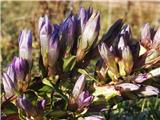 1 1
|
|
|
|
| Apolonija6. 09. 2019 21:05:29 |
Otiv, it's Austrian.
|
|
|
|
| otiv6. 09. 2019 21:34:28 |
Apolonija, thanks for confirming my assessment.
Good morning...
Continuing with the German gentianella, which is the most numerous in hills and mountains. Its feature is the sharp tip between sepals and flowers are at different heights. It grows up to 30cm.
For recognition, close-ups are needed, especially of sepals. If viewed from the top, they look quite similar.
|
|
|
|
| zlatica7. 09. 2019 10:57:23 |
otiv, you've usefully tackled this matter. As I said above, you two with Polona have processed this topic several times already and this time with this approach you'll surely succeed in leading us to the point where we others will also start distinguishing these gentianellas from each other. I don't know why, but until now these gentianellas never pulled me into studying them. But this approach is quite sympathetic to me. What about this one according to you? Is it the cup one, because it has sepals unequal in size and curled outward or not? The shot is taken below Pršivec. I'll browse my photos a bit more to see if there's anything interesting in this regard. lp The shot is taken below Pršivec. I'll browse my photos a bit more to see if there's anything interesting in this regard. lp
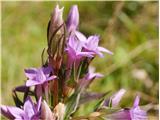 1 1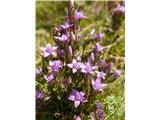 2 2
|
|
|
|
| otiv7. 09. 2019 12:17:22 |
Zlatica, it could be the calyx gentian, but it's hard to recognize its details from the shot, which botanists mention.
During a visit to Dom Planika below Triglav I came across the calyx gentian. The altitude of the habitat convinced me most...over 2400m asl
It was extremely low, so I couldn't even photograph it from below to show the sepals.
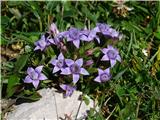 1 1
|
|
|
|
| Apolonija7. 09. 2019 17:12:09 |
Zlatica (you know yourself) and others, well, at least theoretically it's not that hard. For first aid, just keep in mind two things, the shape of the notch between sepals and hairiness.
1. If the notch between them is "U", then it's Austrian. If "V" it can be calyx or German.
2. Between them you distinguish by hairs on sepals. If it has them, it's calyx, if not, German.
Zlatica, on your first picture I sense the hairs more than I see them.
|
|
|
|
| otiv7. 09. 2019 17:35:31 |
I already see my hairs on my arms, but on the gentian's sepals it's harder, even enlargement on computer barely shows them.
|
|
|
|
| zlatica7. 09. 2019 21:29:05 |
Yes, regarding the hairs it's really hard to tell from the picture. I looked at my photo with strong enlargement on the original and of course found them too. So I could say it's really the calyx one. Otherwise, the most reliable will be to check each specimen next season in the field itself. Otiv, your last finding holds true.
Apolonija, your guideline and explanation are excellent, I'll note it down and keep as a rule. greetings
|
|
|
|
| otiv8. 09. 2019 08:56:31 |
I really hope that next year we go together to explore flowers and solve riddles on the spot... have a nice Sunday everyone
 1 1
| (+1) | | |
|
|
|
|
| Zvonček9. 09. 2019 22:20:37 |
On Cres luck smiled on me and I found the dear wondrous flower of Kugy's heart, as he called it himself - pale cephalaria (Cephalaria leucantha).
| (+1) | | |
|
|
|
|
| Zvonček10. 09. 2019 10:20:27 |
Apolonija, THANKS. On picture 4 it's really Scolymus hispanicus. English call it common golden thistle, which I'd translate as common golden thistle, Germans Spanische Golddistel, so Spanish golden thistle, which I think fits better with the adjective hispanicus. Maybe you know the proper name in Slovenian? And thanks also for the yellow bugle. I've never seen it before. Nice regards!
|
|
|
|
| Apolonija10. 09. 2019 18:32:24 |
This biennial they've "Slovenianized" as BLISTER, so Spanish blister
|
|
|
|
| zlatica10. 09. 2019 18:34:27 |
Zvonček, wow what beautiful flowers you found. Only now in the evening I peeked at this page and see surprise. Cephalaria, flowering carrot, gorgeous thistle, and at the end bugle, which I also photographed in June by the sea, and Apolonija told me what it was. Very nice.
|
|
|
You must log in to post a comment:
If you do not yet have a username, you must first
register.