|
| Apolonija7. 09. 2013 21:34:47 |
Brane, the booklet will help you with your enthusiasm for determining. On 47 and 48 the plant has characteristic seeds like little hearts. That's not typical for tormentil, but for cinquefoils, my humble opinion.
Flowers really look like those of the white potentilla, leaves like those of the Spanish one. Maybe they crossed? 
Do you prefer the single-pinnate avens to the feathery one?
I always admire the foliage of the alpine avens when the mountain glows, but I prefer to drink the evergreen one
|
|
|
|
| Apolonija7. 09. 2013 23:32:06 |
jprim, your plant reminds me of Peruvian groundcherries /Physalis peruviana/. Lp
|
|
|
|
| velkavrh8. 09. 2013 06:52:22 |
Apolonija, you were right. My unknown flower almost from the top of Begunjščica really belongs to crucifers, hence the seeds. It was overgrown bladderpod.
I noticed another interesting thing about aconites in the Flora alpina handbook. Our narrow-helmeted aconite isn't mentioned at all - mentions three-golden, common - they have growth like narrow-helmeted but different leaves and coastal one, which probably grows there and has growth like Lobel's - not so dense flower growth. With blue ones I know we determine exact species only with a lens - I mean Turkish and tail aconite.
|
|
|
|
| Apolonija8. 09. 2013 08:25:38 |
Good morning! As I read, Aconitum lycoctonum has several subspecies: narrow-helmeted, golden, common....
Zaplana.net:"From related subspecies you distinguish narrow-helmeted aconite by these traits:
inflorescence shape: inflorescence is dense (common aconite has more branched inflorescence);
position of inflorescences: side branches can be widely spread, golden aconite has side branches directed upwards;
leaf shape: leaves usually divided to less than 3/4 of leaf surface, segments broad, leaves of golden aconite deeper divided, their segments elongate;
hairs on flowers and pedicels: narrow-helmeted aconite has curved hairs, common straight..."
Could your aconite in the pic also be golden (Aconitum lycoctonum subsp. ranunculifolium)?
Leek? Do you think it's not Allium ericetorum /pale leek, yellowish leek/?
Tonight full of flowers again???
|
|
|
|
| jprim8. 09. 2013 09:16:41 |
So Apolonija, I'll investigate in that direction - Peruvian groundcherry????
|
|
|
|
| jprim8. 09. 2013 09:25:51 |
Darn, now I've realized too late that I had a medicinal plant in the bed, which I just threw on the compost , when researching this Peruvian berry, I found out those red lanterns contain valuable substances, but I ... , when researching this Peruvian berry, I found out those red lanterns contain valuable substances, but I ...
But about this Peruvian one, I found no pics to compare.
LP!
|
|
|
|
| Apolonija8. 09. 2013 12:25:26 |
... first time I heard of night catchfly. By name—Silene noctiflora, flowers at night. Probably it's bladder campion on your picture. On the BV picture the plant is different, similar to clammy, look: http://www.botanicni-vrt.si/component/rastline/silene-noctiflora
Stem and calyx leaves are hairy. Plant is annual, sometimes weed, smells.
Brane, do you maybe have some picture of garden catchfly from abroad?]]>
|
|
|
|
| velkavrh8. 09. 2013 12:57:08 |
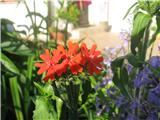
This is picture of my catchfly, which I don't see in the village. I also know garden campion—Silene armeria, but it has smaller flowers and thinner spreading stem. Usually two stems grow from axils and at the end of the stem several small flowers emerge.
Narrow-helmeted (pale yellow) monkshood I photographed several times this year on several hikes. I'll check the shots.
This light, yellowish gentian I spotted for the first time this year on hike to Ledine and now at Born's tunnels. I'll check if they are the same. For Ledine I'm sure it's the real one, for Karavanke where Born's tunnels are, I don't know. Checked with Alenka—only this yellowish gentian grows in our mountains, similar stone gentian is on Kras.
Regarding monkshood, the following. Flora alpina clearly defines it as common monkshood—recognized by leaves and the spur on flower, which is indistinct in common. I'm sending picture of golden one.]]>
 1 1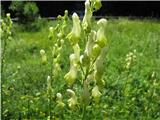 2 2
|
|
|
|
| Apolonija8. 09. 2013 13:59:33 |
I saw this gentian for the first time on the path to Debela peč.]]>
|
|
|
|
| Apolonija8. 09. 2013 18:52:40 |
Ranunculus=genus
lycoctonum=species
subspecies=subspecies /neapolitanum, vulparia, lycoctonum.
All three are subspecies and differ from each other. On your photo it's narrow-helmeted monkshood (Aconitum lycoctonum subsp. lycoctonum) and not A. ly. vulparia!
Do you agree? I don't know if I wrote understandably
In the Ljubljana botanical garden they have these monkshoods:
LATIN NAME SLOVENE NAME FAMILY (LATIN) FAMILY
Aconitum degenii subsp. paniculatum branched monkshood Ranunculaceae buttercup family
Aconitum lycoctonum subsp. lycoctonum narrow-helmeted monkshood Ranunculaceae buttercup family
Aconitum lycoctonum subsp. ranunculifolium golden monkshood Ranunculaceae buttercup family
Aconitum lycoctonum subsp. vulparia common monkshood Ranunculaceae buttercup family
Aconitum napellus tassel monkshood Ranunculaceae buttercup family
Aconitum orientale eastern monkshood Ranunculaceae buttercup family
Aconitum sp. monkshood Ranunculaceae buttercup family
Aconitum variegatum variegated monkshood Ranunculaceae buttercup family
Aconitum vitosanum Vitosha monkshood Ranunculaceae buttercup family
Aconitum x cammarum 'Bicolor' monkshood, hybrid Ranunculaceae buttercup family
Aconitum x hebegynum monkshood, hybrid Ranunculaceae buttercup family
]]>
|
|
|
|
| velkavrh8. 09. 2013 19:48:12 |
This afternoon I amused myself with chickweeds. I know determination is very demanding, if not impossible. Flora alpina lists 28. Here supposedly 21 grow. I reviewed all hikes and chickweed photos on individual hikes and tried to identify. Somehow I identified only 6.]]>
|
|
|
|
| Apolonija8. 09. 2013 21:36:29 |
Good job identifying so many chickweeds, to me some seem the same. Chickweed on first and second picture should be one-flowered. Seems to me the second has different leaves, too sharp for one-flowered. Isn't it possible it's also rock chickweed - Cerastium julicum??]]>
|
|
|
|
| velkavrh9. 09. 2013 04:21:53 |
Do you read my private mail?]]>
|
|
|
|
| Apolonija9. 09. 2013 07:52:24 |
Up to now I haven't. I wasn't paying attention and didn't even know it exists, sorry.]]>
|
|
|
|
| Apolonija9. 09. 2013 22:54:34 |
Kobulnica ženikelj also came to my mind, which is used for treating bruises, bleeding...
I don't know if rozenikl is exactly the Slovenian term, but apparently it's the name for Saxifraga crustata, crusty saxifrage.
|
|
|
|
| velkavrh10. 09. 2013 15:26:13 |
I researched our lakote a bit and now the results. In Flora alpina 51 are listed - of that 28 grow here with us.
|
|
|
|
| doripiki10. 09. 2013 21:03:29 |
Probably it's Zenikelj since the shepherdess couldn't tell me the exact name, it really is a medicinal plant
Thanks otiv and apolonija
I wonder if anyone has seen it already in our hills
|
|
|
You must log in to post a comment:
If you do not yet have a username, you must first
register.