|
| JusAvgustin10. 02. 2010 13:15:02 |
life has no price, transceivers still do for now. If you seriously hike mountains in winter or ski tour, it's the most important thing. Otherwise a good set costs around 500. Abroad avalanche gear is mandatory for ski tourers. Transceiver 360, shovel 70, probe from 50 up...  , but what is that compared to consequences? , but what is that compared to consequences?
|
|
|
|
| spetovar10. 02. 2010 13:30:08 |
Yeah that's true what you say and I agree with what you and tol said. But that doesn't change the fact that the gear isn't some technological wonder that's super complicated, yet expensive as if they just discovered RF. If you look at materials for making a transceiver, I don't think it'd exceed 20$ much. Not to mention probes. But that's how it is and for now we can't do anything. If I went abroad nonstop I'd get it without thinking. Here it'll take time until mountaineers' awareness (including mine) is sensible enough that everyone has transceivers.
|
|
|
|
| tol10. 02. 2010 13:32:19 |
I'll ask differently.
What gives you better chances of being found in Slovenian mountains if an avalanche buries you: avalanche transceiver or avalanche airbag?
Or if deciding to buy, what should I rather get: transceiver that 20% of winter mountain visitors have or avalanche airbag that anyone can find in avalanche without any gear?
Regarding target market: I think the hiking, trekking and alpinism shop market is doing well. There are plenty of shops but it doesn't reflect much in competitive prices.
80% don't have transceivers here, I think mainly because of price. I think if it were more affordable price-wise the percentage would be much better in favor of use.
True that I also don't understand our country insisting on VAT for products like avalanche gear, helmets (mountaineering, cycling, motorcycling).. I think the state could contribute here and exempt such things from tax payment. In UK I know cycling helmets are exempt from tax.
| (+1) |  | |
|
|
|
|
| spetovar10. 02. 2010 13:42:44 |
Tol, don't talk too much about the tax, some state employee might read this forum, they'll raise hell even more 
Otherwise I join your opinion.
I decided rather to invest in knowledge and gradually acquiring experiences than equipment, since the first one comes in handy even if you hike alone (which I often like).
Which doesn't mean I'm right, as I wrote above, I also need to change my thinking that the transceiver isn't just some gimmick.
|
|
|
|
| stefanb10. 02. 2010 14:21:06 |
Even if we're alone, using the transceiver isn't senseless. Regardless of what is with us under the avalanche, alive or dead, the transceiver signals the location. And that shortens the search time and thus reduces the rescuers' exposure to also being buried themselves to a minimal time. That counts for something.
|
|
|
|
| tol10. 02. 2010 16:33:57 |
We drifted far from the original idea, whether it's possible at home for relatively little money to make an avalanche ball thing and if it would work in the end.
And nobody wants to touch the above question what's better: ball or beacon?
Ball has advantages: anyone can find it without knowledge or gear.
Beacon even if you have it, you need to know how to use it. And probably combination of poor knowledge and "shock or panic" from avalanche, searching for victim can take quite long. On the course some struggled with finding buried beacon.
|
|
|
|
| a4si10. 02. 2010 17:20:24 |
My thinking:
BALL is interesting idea, but how with it in practice? Couple questions come to mind:
- how/where to carry it so you can throw it very easily?
- if avalanche surprises you, do you even have time to throw it?
- can some ice chunk in avalanche puncture it? will it then "sink" in avalanche?
- how long cord? longer it is higher chance it tangles and goes with you under avalanche...
- still need at least shovel from mandatory gear (or those searching you): on average buried at 1-1.5m depth and you can forget digging by hand, especially if snow is a bit compacted (personally checked on avalanche course - even with shovel takes eternity, bare hands no chance...)
- and more could be found...
BEACON:
- just one comment: "if you have it, learn to use it..." in my opinion no problem to take half hour break on every tour and practice a bit (at least I do)
Otherwise always together: beacon, probe, shovel - one without others helps almost nothing...
|
|
|
|
| tol10. 02. 2010 17:48:17 |
The cord is packed or folded and you don't drag it behind. Throw it if avalanche breaks loose.
|
|
|
|
| sebanakis10. 02. 2010 19:12:15 |
Avalung system is simple, the tube ensures that you suck air from small air pockets in the snow and thus extends your life. And on the other side you have CO2 inlet. Of course it depends a lot on snow type... as for airbag, shovel and probe, you need lots of practice before you are really used to working with it. Shovel, probe and airbag kit 199.90 with discount 159.92€. Some jackets already have recco system, but the problem is that the cell phone signal interferes with it, at least as far as I know the issue.
|
|
|
|
| Santi10. 02. 2010 19:29:23 |
Tol, aren't you by chance from the avalanche institute in Davos 
|
|
|
|
| stefanb10. 02. 2010 19:47:29 |
You can go with a balloon, you can go with an airbag, but shovel and probe still go with it. Without a shovel, 15 minutes pass quickly. Plus some course, experience, a guide at the beginning, then a bit of luck and a lot of common sense, because nothing is 100%, and mountains can be beautiful in winter and summer.
|
|
|
|
| tol10. 02. 2010 20:29:29 |
Percentages are approximations, but I'm sure that in Slovenian mountains in winter, around 20 to 30% of mountaineers/alpinists use avalanche airbag. REs every year and this percentage increases.
The other 80 or 70% have nothing. And if an avalanche buries you, those 70 to 80% mountaineers without gear will more easily find the buried one who has an avalanche balloon than one with airbag.
Understand?
I don't deny that airbag works. On the contrary, it does. But under conditions where airbag is used en masse.
Realistically: even if I afford an airbag myself, the buddies I go to the mountains with, in the current situation, can hardly scrape together money for an airbag purchase. So the situation is: avalanche buries me, I use airbag, buddies don't. So it hardly helps me. If I used a balloon, in case it stays on the surface, buddies would at least follow the balloon and rope and could locate me.
|
|
|
|
| tol10. 02. 2010 20:37:01 |
Sadly the debate isn't going in the right direction. Namely towards finding an answer if an inflatable object in most cases stays on the avalanche surface or gets buried like the person.
Avalanche balloon was presented on gore-ljudje.net and also on GRZS.si
I don't know, the purpose of the topic was to seek answers, but there are few concrete arguments. Sadly the debate developed in the direction: buy airbag because it works.
Let's think outside the box:
most mountaineers are unequipped and what's wrong if a product even homemade could contribute to greater safety? I don't care about mockery. If it worked it would be just a plus.
I'll ask again a bit differently: What interests you more. That unequipped mountaineers without airbags at least use homemade avalanche balloons or nothing at all?
|
|
|
|
| tol10. 02. 2010 20:55:38 |
Another silly idea occurred to me!
Almost everyone uses a metal thermos. Or even better ice axe and crampons. Too much metal for this:
http://www.enaa.com/oddelki/conrad/izd_3661_CO674575_Detektor_za_kovine_Security_Plus
Am I exaggerating already? Just don't see why it wouldn't work.
Only problem would be if it sweeps aside the ice axe and backpack with thermos. Then there would be multiple points indicating a metal object.
|
|
|
|
| Zebdi10. 02. 2010 20:58:07 |
Basically the thing is quite simple; everyone should have what they believe will help them in case of burial - be it a talisman, transceiver, balloon or even a helium balloon. I decided to buy an avalanche kit - i.e. transceiver, shovel and probe. And of course company of good friends, with whom we DO NOT go into dangerous conditions. Will it help me? I hope
|
|
|
|
| IgorZlodej10. 02. 2010 21:44:29 |
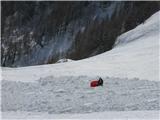
According to some unofficial estimates, only 15% of winter mountain visitors in Slovenia use avalanche kit, including responsible skiers who ski off-piste so-called freeriders. Equipping in this direction is slowly growing, but things would change quickly if, for example, handled also through insurance, issuing bills for rescue costs in cases where the affected obviously neglects these safety factors or in plain words doesn't equip appropriately for winter mountain visits. Meanwhile experts in this field constantly work to update current gear with improvements and develop new aids, but it's necessary to know that none of them is omnipotent and it still holds that the most important is own appropriate assessment of conditions and own abilities, and consideration of avalanche danger warnings, use of practical knowledge and experience.
 1 1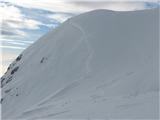 2 2
|
|
|
|
| stefanb11. 02. 2010 13:49:40 |
"use at least homemade avalanche balloons".
As long as you use such a balloon yourself, no problem. When you start making such balloons, giving them away or selling them, you also take responsibility that the thing works or doesn't tear or burst. And to prove that, you need to certify it. And that all costs money. And we're back to money.
Anyway, anything is better than nothing.
|
|
|
|
| tol15. 02. 2010 18:33:01 |
Does anyone else have an avalanche cord?
Google finds almost nothing.
If any "experienced" mountaineer still has a specimen at home, I'd be grateful for a photo.
Regards
|
|
|
You must log in to post a comment:
If you do not yet have a username, you must first
register.