|
| malenka20. 11. 2020 12:16:24 |
Alpine bluegrass (Poa alpina)
Type: Grasses
Family: grasses
| (+1) |  | |
|
|
|
|
| velkavrh21. 11. 2020 08:24:45 |
I'd like to comment a little on malenka's flora presentations.
The alpine mountaineer is wonderful in autumn when its cushions turn red. Unfortunately I didn't have that opportunity this year.
I searched for the thistle a couple of years ago around Stahovice but didn't find it.
Two subspecies of thick-leaved thistle grow here. As I know they differ by leaves. I don't know the differences.
I don't know grasses and ferns.
The flower of the brook speedwell is something special. The name already says it likes moist habitat.
I know long-leaved scabious - we find it higher than the usual highland one and some others. Hoppe mentions even the woodland one - Knautia dipsacifolia in his handbook. I don't have access to Small Flora of Slovenia to check scabious here.
Short-haired pearlwort I don't know well. But I know mossy one well.
Narrow-leaved monkshood is our endemic of the Julian Alps. Malenka already taught us about monkshoods.
Alpine butterwort is also called celinka locally. They used it for wound healing.
About Lloydia Apolonija said a lot in 2015. He mentioned that there are about 20 species. Many grow in Asia. Only common Lloydia grows here. Lloydia is named in the handbook Botanical Path Črna Prst and also on Katričin ornamental garden forum.
Nice regards and stay healthy!
|
|
|
|
| Majdag22. 11. 2020 10:00:17 |
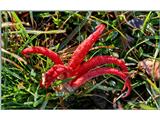
Strange little flower like a sea star among grasses, photo: J. Medvešek.
 1 1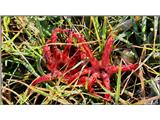 2 2
|
|
|
|
| velkavrh22. 11. 2020 10:20:59 |
Majdag I think it's a fungus - called great stinkhorn - Anthurus archeri. I saw it this year too as well as similar common latticed stinkhorn - Clathrus ruber. Both fungi are really unusual and inedible. Three decades ago I delved into the mushroom world but after Chernobyl I quit mushrooming. Some memory of our mushroom riches remains though.
| (+2) | | |
|
|
|
|
| Majdag22. 11. 2020 10:53:20 |
velkavrh, malenka, thanks..
|
|
|
|
| malenka22. 11. 2020 12:08:54 |
Velkavrh, the dioecious helleborine is a low plant that grows on marshy terrain. I don't know which species is on pictures 1 and 2, because the lower leaves are not visible; I have some doubts. On picture 3 it's already the mountain helleborine, on picture 16 the tripartite one. For the hill helleborine I don't know how you identified it, it's not quite easy; the stem is densely hairy (yours doesn't!) but otherwise it grows on dry slopes. The tuberous helleborine, which is otherwise similar to the dioecious one, grows on dry karst terrain (in Primorska, also on Cro. islands) and has a very rounded inflorescence, with tubers in the ground. The meadow, forest, and elder-leaved ones I also don't know.
In helleborines dioecy is common, meaning some plants have only male flowers with stamens, others only female plants with pistils, so they look different, almost like two different species.
|
|
|
|
| velkavrh22. 11. 2020 12:54:11 |
I always see dioecious helleborine when going to Kamniški vrh from Ambrož - there grow large bellflowers - campanulas - I checked - but I don't have a good full plant. I photographed hill helleborine also on Kamniški vrh. I know it is similar to medicinal valerian in leaves. These two helleborines have only such leaves.
|
|
|
|
| malenka23. 11. 2020 09:30:03 |
Braun's cinquefoil (Potentilla brauneana)
Species: Flower
Family: Rosaceae
Color: yellow
It is an alpine plant, only up to 5 cm high. It has small leaflets, 1-1.5 cm long, sparsely hairy on underside and margin, ternate. Stem rarely has more than one flower. Petals mostly longer than sepals.
On high mountain meadows and in snow hollows it blooms mid-summer, soon after the snow melts.
Present from Pyrenees to Eastern Alps and Karawanks.
| (+1) | | |
|
|
|
|
| malenka23. 11. 2020 09:36:03 |
Mealy primrose (Primula farinosa)
| (+1) | | |
|
|
|
|
| malenka23. 11. 2020 09:42:31 |
Spring primrose (Primula veris agg.)
Species: Flower
Family: Primulaceae
Color: yellow
The group of spring primroses has three subspecies in our region.
| (+1) | | |
|
|
|
|
| malenka23. 11. 2020 09:47:26 |
Striped daphne (Daphne striata)
| (+1) | | |
|
|
|
|
| malenka23. 11. 2020 09:56:09 |
Spring pasqueflower (Pulsatilla vernalis)
| (+1) | | |
|
|
|
|
| malenka23. 11. 2020 09:59:22 |
Teratological buttercup (Ranunculus hybridus)
| (+1) | | |
|
|
|
|
| malenka23. 11. 2020 10:04:04 |
Rock bramble (Rubus saxatilis)
| (+1) | | |
|
|
|
|
| malenka23. 11. 2020 10:09:26 |
Clustered dock (Rumex conglomeratus)
| (+1) | | |
|
|
|
|
| malenka23. 11. 2020 10:25:08 |
Blunt-leaved willow (Salix retusa)
Type: Shrubs
Family: willow family
Color: yellow
Dwarf, creeping shrublet with sprawling, gnarled shoots has small (1-3 cm), inversely ovate or lobed leaves, which are blunt at the top, glabrous, dark green. Male and female catkins are on different plants, are 2-3 times as long as wide.
Distributed above the forest line in the Pyrenees, Jura, Alps, Apennines, Prokletije.
| (+1) | | |
|
|
|
|
| malenka23. 11. 2020 10:45:09 |
Thyme-leaved willow (Salix serpyllifolia)
Type: Shrubs
Family: willow family
Color: yellow
Dwarf, creeping shrublet with densely broom-like sprawling, cushion-like shoots has tiny (under 1 cm), ovate leaves. Male and female catkins on different plants, roundish, with only 2-8 flowers in each catkin.
Distributed on moist scree and rocks in the alpine belt mainly throughout the Alps.
| (+1) | | |
|
|
|
|
| malenka23. 11. 2020 10:51:28 |
Common sage (Salvia officinalis)
| (+1) | | |
|
|
|
You must log in to post a comment:
If you do not yet have a username, you must first
register.