|
| velkavrh3. 07. 2015 17:41:50 |
zlatica you present me a training ground for recognizing mountain flowers. I love browsing what you find and photograph. Let's see what I studied:
nos. 3 and 4 are rock campion-Silene rupestris. This low campion has no teeth like others.
nos. 5 and 6 - it's low campion-Silene pusilla
nos. 11 and 12-mountain sandwort-Heliosperma alpestre. Sandwort resembles low campion by flower. Flowers are a bit larger in sandwort and it has longer stronger stem. As far as I know there are other sandworts too.
no. 9-right-we recognize alpine krešica by characteristic leaves.
14 and 15 are Scheuchzer's bellflower-characteristic medium height bellflower, full on alpine meadows.
no. 31-Bavarian primrose, even smaller is Carniolan primrose.
no. 63-65 is Wreden's lousewort.
no. 66-spring gentian
no.78-common mountain speedwell
no. 68-wood stitchwort -Stellaria nemorum
no. 32 and 33-in this area only Kamnik bramble grows.
no. 42-in recognizing and determining wormwood and yarrow there's some confusion. These leaves are definitely yarrow. Many throw both in same basket which they aren't (mountain wormwood, mountain yarrow, white yarrow) Your yarrow is mountain yarrow-Achillea clavennae. Maybe someone determines it as dark yarrow-Achillea atrata. According to Hoppe dark one grows in Central and Eastern Alps and west to Savoy Alps. It would be good to check what Flora Alpina says.
no. 24-wood vetch -Vicia sylvatica
|
|
|
|
| Apolonija3. 07. 2015 17:43:11 |
Zlatica, I admire you. You're more active than the men here.
My answers to questions in order:
- not hairy cinquefoil because of petal shape, probably campion - Silene rupestris
- sandwort,
- Scheuchzer's bellflower
- instead of vetch it's alpine milk-vetch
- maybe it is Kamnik bramble
- dark yarrow, mountain one has similar flowerheads to common, yours has quite large outer bracts
- Vrednik's lousewort
- Sieber's rampion Phyteuma sieberi
- wood stitchwort
- one of dead nettles. those shoots are fruited remains after flowering.
|
|
|
|
| Apolonija3. 07. 2015 17:45:27 |
I see that Brane and I wrote simultaneously again and concluded approximately the same. However: mountain yarrow doesn't have such leaves as in the picture and they also have whitish farina.
|
|
|
|
| velkavrh3. 07. 2015 17:51:26 |
Apolonija, I overlooked the rampion. It grows from rock crevices and is quite low. The head-shaped one grows more on alpine meadows.
Alpine kidneyvetch won't be it!
Under no. 13 is creeping baby's breath - Gypsophila repens.
For these two cinquefoils we need to delve deeper. Hoppe says that Cratzer's stem is hairy, leaves palmately divided, leaflets serrated saw-like on edges, upper appressed, lower protruding hairy. Best to have this manual always with me.
|
|
|
|
| Apolonija3. 07. 2015 18:03:56 |
You surely know it better. To me the leaves seem leathery so I thought faded alpine kidneyvetch. What do you think it is?
I agree with baby's breath, I forgot to write it.
Cinquefoils. More than hairs, the middle tooth on leaves helps me, which in the golden one is shorter than the neighbors. I looked with a magnifier. Hardly visible. It seems to me that it's not the golden one on the pictures.
Rampion has characteristic involucral leaves.
|
|
|
|
| Apolonija3. 07. 2015 18:24:08 |
I see you additionally noted above - wood vetch and that will be the right one.
|
|
|
|
| zlatica3. 07. 2015 18:38:26 |
Oh, how active you two are. I'm really grateful to you, as you always have what others don't know. I accept almost all, only for Sieber's rampion I was surprised, because I don't know the real difference between head-shaped and Sieber's. Is it only about habitat - rocky? For cinquefoils this seems a good contribution, and you probably know it http://www.gore-ljudje.net/novosti/75817/. I always try to photograph from all sides, but still not close enough, especially leaves. Yes, at the top I was more eager for rest than photographing, haha, which you probably believe me, as the path for such vintages as me is not easy at all. Campions I'm just slowly getting to know now and I distinguish some, they are very interesting. Wreden's lousewort is so compact here on the mountain that I didn't recognize it. And dead nettle?! Yes, good Apolonija, that I now know this peculiarity too. Branko, is it really Bavarian primrose, isn't that the small one, as it seemed very small to me. Now based on your findings I studied FA more and there are drawn leaves, what they should be like for one and the other and to me it looks more like golden cinquefoil, when I enlarged the picture. Attaching two more photos, where there are more leaves, maybe you'll see better. 
Yes, one more thing, what do you say about 52 and 62? As it seems to me, they are the same flower.
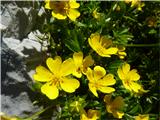 1 1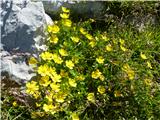 2 2
|
|
|
|
| velkavrh3. 07. 2015 19:37:23 |
I somehow missed these two pics - 52 and 62. Of course it's the same flower. This is sticky sandwort - Moehringia ciliata. But all these white flowers are harder to recognize. My colleague tells me, when all the sandworts, sticky sandworts, mouse-ears and even alpine chickweed are so similar. Only the wide-leaved mouse-ear is easier to recognize because it's too green.
|
|
|
|
| zlatica3. 07. 2015 20:58:07 |
Branko, your colleague is absolutely right, that's why I'm trying to get into this "similarity", but still difference and it's nice that you're helping me with it. Apolonija, that's exactly the page I needed, but I don't know how I didn't notice it, although I often check Zaplana.net. When I'm next time(??!) on Košuta, a piece of rampion will come with me so you can more easily determine the species  . .
|
|
|
|
| francimedved4. 07. 2015 21:40:08 |
Today I walked a bit on the meadows under Šmarna gora.
|
|
|
|
| Apolonija5. 07. 2015 00:55:49 |
Franci, you're back!
- bloody cranesbill
- it's woodrush (Luzula sylvatica)
- it's bearded pink as you say
- common barren strawberry
|
|
|
|
| francimedved5. 07. 2015 18:43:35 |
Apolonija thanks, I corrected it, hope correctly.
|
|
|
|
| otiv6. 07. 2015 13:27:42 |
Hi Brane!
Doesn't anyone else in your hiking club care about flowers like you? In PD Celje Matica there were quite a few of us and I never had problems not being able to photograph flowers or some other interesting subject. Such a trip doesn't happen every day and you need to take time for photography too.
| (+2) |  | |
|
|
|
|
| francimedved6. 07. 2015 16:03:24 |
Excellent Otiv, in our club it's about the same, to the top as soon as possible, then sleep up there.
|
|
|
|
| zlatica6. 07. 2015 17:14:08 |
Branko, you've cheered us up again, there was already a real drought with flowers here. You even caught gentian, alpine ragwort and nice bramble and also hairy - you mean bearded bellflower, right? Cross-leaved rockjasmine always escapes me, I haven't managed to meet it yet. Well, this marmot is new to me too. Enjoy identifying...
|
|
|
|
| Apolonija7. 07. 2015 07:10:55 |
Brane, I join Zlatica regarding the joy. Still, you took quite a lot of new photos, even though you didn't have much time.
Could the first clover be common Turkish clover?
I'm curious how you figured out it's Petkovšek's poppy and not Rhaetian. And northern bedstraw and not rock bedstraw (Galium saxatile).
Lp
|
|
|
|
| velkavrh7. 07. 2015 11:13:22 |
Already on our side of the Julian Alps, Kerner's poppy is replaced by Petkovšek's poppy. The flowers are the same, the leaves differ. It's also similar to Rhaetian poppy - so it could be that too.
I don't know rock bedstraw. I identified it according to Hoppe.
Now I'm really waiting for the Vodnik hut, Verner included. I'll look for Triglav neboglasnica. I didn't see it in the Dolomites, nor Clusius' bellflower.
|
|
|
You must log in to post a comment:
If you do not yet have a username, you must first
register.