|
| Daaam4. 02. 2013 12:31:24 |
Well... how many Hribi.net users plan to cross Monte Rosa massif? ..the one who does will know for himself how long his knees hold.. Fact is everyone has their own knees and some give out sooner, not because of spoiling..others later. Everyone decide for themselves how and what. Everything comes with experience. Personally I use them as a rule, of course sometimes I do a tour without poles so I don't get too spoiled  ..I miss them on descent then ..I miss them on descent then ..sometimes protects my left a bit.. ..sometimes protects my left a bit..
| (+1) |  | |
|
|
|
|
| pikica14. 02. 2013 12:56:02 |
@urarr you're a bit off topic. This is forum for hikers mountaineers. I've been hiking for quite some years, I don't remember ever crawling on all fours to a hut.
Glacier rope team and eternal snow, you're a bit funny man. That's why they're called hiking poles, because hikers use them. Alpinist will grab something else than poles.
| (+4) | | |
|
|
|
|
| dprapr4. 02. 2013 13:00:46 |
If we want to do a tour at such an altitude, we can certainly rely also on the condition gained with the help of poles. Of course, if we didn't stroll on the flat.
For training I always use pathless, forested or rocky terrain, as steep and varied as possible. There poles are a great help, especially for exercising arms and shoulders.
On descents though mileage does its thing, no matter how enduring we are. Why not extend the lifespan of the knees if some aid allows it.
I remember that about 16 years ago I was a big opponent of poles myself. But things change and we with them, whether we like it or not.
| (+3) | | |
|
|
|
|
| šodrovc4. 02. 2013 13:38:43 |
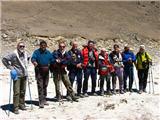
Veterans of Everest expedition
Photo: Viki Grošelj
 ...yeah, poles seem useful... ...yeah, poles seem useful...
 1 1
| (+8) | | |
|
|
|
|
| urarrr4. 02. 2013 13:52:11 |
| (+1) | | |
|
|
|
|
| DarjaZaplotnik4. 02. 2013 21:22:30 |
@lakkon
Tehnomat has quite a few products so I couldn't just rattle off what all comes in the kit.
You have the contact number on ZS for first-hand info.
@urarrr for you: in practice when crossing very long flat and moderately crevassed glaciers (like the case you mention) we often use a trekking pole in the free hand. Hands not put in the loop so we can ditch it instantly and use ice axe.
I use this technique often in less steep snow sections too, just shorten the pole appropriately.
regards d
| (+4) | | |
|
|
|
|
| IgorZlodej5. 02. 2013 07:37:53 |
Wow, you wrote a lot. I've been using trekking poles for 24 years, some aren't even that old but want to say something  , well, OK. Many have broken, joints have failed, not for show or monthly Sunday hikes. Brands matter maybe for price. Key is usefulness. Tehnomat is good, not because it's cheap but they replace/repair parts. Need maintenance: disassemble, wash, dry, assemble. No need to collapse after every hike, it wears joints. Baskets important for winter, big adaptable ones. Deep snow support, hard ground no slip, tip matters, Tehnomat perfect. Poles whole science. Also proper backpack attach, some clueless. Tips always up, not too high, no snag. , well, OK. Many have broken, joints have failed, not for show or monthly Sunday hikes. Brands matter maybe for price. Key is usefulness. Tehnomat is good, not because it's cheap but they replace/repair parts. Need maintenance: disassemble, wash, dry, assemble. No need to collapse after every hike, it wears joints. Baskets important for winter, big adaptable ones. Deep snow support, hard ground no slip, tip matters, Tehnomat perfect. Poles whole science. Also proper backpack attach, some clueless. Tips always up, not too high, no snag.
| (+3) | | |
|
|
|
|
| jani bele5. 02. 2013 17:48:29 |
I'd add to Igor's last sentence: the pole straps on the backpack shouldn't hang too low. Although this sounds a bit odd, in the recent accident below Kokrsko sedlo the guy snagged his crampon on the strap, and the head-first fall and slide were inevitable.
| (+5) | | |
|
|
|
|
| viharnik5. 02. 2013 18:04:05 |
Often even experienced mountaineers attach poles to the pack with tips pointing down. Then on a fall we snag the slope and it suddenly twists us in the fall, or we can nicely spike the calf. On steeper descents the poles catch on rocks and throw us off balance.
I have the poles nicely tightened with side straps tips up, and the straps additionally clipped with the smallest key carabiner, which is placed on the lower side strap of the backpack.
|
|
|
|
| GregorC5. 02. 2013 18:18:23 |
I remember years ago an older man "warned" me to turn the tips down before I spike someone.
|
|
|
|
| ljubitelj gora5. 02. 2013 18:21:12 |
If you know poles so well, where can I get some affordable ones in Ljubljana, the 80 euro ones are too expensive for me.
|
|
|
|
| viharnik5. 02. 2013 18:30:18 |
In K2 Alpinist Fizan poles - Made in Italy around 30€.
|
|
|
|
| strelec19545. 02. 2013 19:00:55 |
Poles are not really any kind of luxury, they are a tool just like ice axe, crampons, backpack... etc. I've been using them for thirty years and they seem to me an excellent aid in the mountains.
I've broken quite a few and found that if they are very cheap, they are usually also very crappy. LEKI suit me, they are not exactly cheap but they have spare parts which is not negligible.
| (+2) | | |
|
|
|
|
| Irina5. 02. 2013 23:20:30 |
I got Gabel poles as a gift, where would you classify those?
| (+1) | | |
|
|
|
|
| sla6. 02. 2013 08:07:52 |
Irina - subcategory: don't look a gift horse in the mouth :-)
I used some of the first Leki poles for a long 12 years - satisfied without comments. Then I used Leki Makalu Superlight (or something like that), until some poles were blown away from me on Elbrus... In between I had some of my brother's poles, which were stolen from me somewhere in Kamniška Bistrica. Now I use some poles (Master, if I'm not mistaken), which I bought relatively cheaply a couple of years ago at Iglu. They are quite okay. But really, for skiing I use one-piece poles. Collapsible ones are only for walking, so I wouldn't philosophize too much here. The only important thing to me is that they have a quality carbide tip.
So does anyone know where I could get cheap (under 50 EUR) one-piece poles with carbide tip?
|
|
|
|
| Daaam6. 02. 2013 08:45:05 |
|
|
|
|
| sla6. 02. 2013 09:50:39 |
Daaam - won't work. I'd like non-collapsible poles of 110 cm length. Now I had Hofer ones, which performed excellently, but on one after more than 6 years of use the tip broke.
|
|
|
You must log in to post a comment:
If you do not yet have a username, you must first
register.