|
| lanževica20. 05. 2012 17:40:38 |
Yesterday on the path from Kamniški vrh I almost poked a snake with my stick. It was lying in the middle of the path, like a root and completely still. But I was without a camera. It was light brown with a distinct darker zigzag. Oh, adder. Unfortunately I can't boast that the snake was as thick as e.g. my wrist, well maybe it was still young and more slender. You'd think it would at least hiss angrily, but even when I stumble upon a snake, it acts like it's dead and completely harmless. The path is narrow, can't bypass it, need to gently remove it from the path. I'm interested if it's possible that this non-aggressive creature isn't an adder at all, but a smooth snake. I looked at some pictures, it could be one or the other. Does anyone know if such behavior is typical perhaps for non-venomous snakes?
|
|
|
|
| Karletto20. 05. 2012 19:47:21 |
As far as I know, the snake plays dead by curling up and turning onto its back. It would help if you tell us the time of the encounter and the type of terrain too. Namely, if the encounter happened somewhere in the middle of the forest i.e. in shade or early morning, its body was still cold and so it couldn't withdraw.
Another option is that it had just fed and simply didn't feel like it. Siesta. 
| (+1) |  | |
|
|
|
|
| urbancek20. 05. 2012 20:53:51 |
The adder surely won't play dead, unless some specimen has already finished it off with a stick beforehand and it's actually really dead... 
|
|
|
|
| godovčan20. 05. 2012 22:42:29 |
yesterday I was on Jerebica and met about 5 adders and one nose-horned viper that immediately bit into the hiking pole without me touching it, just unintentionally I was too close to it, because it was completely unnoticeable right by the path and that at 2000m.
 1 1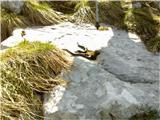 2 2
| (+2) | | |
|
|
|
|
| Branee20. 05. 2012 23:39:03 |
and what then on the picture are you waving the stick around the snake? Are you provoking, once it will be returned with interest
and don't tell me you took the pic right there while hiking because that simply doesn't hold up
|
|
|
|
| lanževica21. 05. 2012 07:51:56 |
Well, my "snake" I encountered on the narrow trail that crosses the steep grassy slopes of Kamniški vrh, at a height of about 900-1000m. It was around 2 pm and very hot. Obviously based on behavior it was really a smooth snake resting after lunch
Branee, the stick there is surely just for comparison, not for waving around the snake
| (+2) | | |
|
|
|
|
| urbancek21. 05. 2012 11:02:45 |
godovčan: no nose-horned vipers at 2000m, not even at 1500m..
|
|
|
|
| Okmodko21. 05. 2012 11:24:47 |
Urbancek, one of the most important characteristics of the nose-horned viper is that it is found at high altitude. Not only 2000m but also higher. Once I read somewhere that they found it in one country at around 3000m. It likes living on bare areas and less so in forest. That's why 2000m is ideal for it.
|
|
|
|
| urbancek21. 05. 2012 11:39:55 |
That applies to the adder...
|
|
|
|
| Okmodko21. 05. 2012 12:01:12 |
And nose-horned viper. If you don't believe me you can read on IUCN. They have some idea about animals I think. Otherwise both are vipers anyway, genus Vipera.
|
|
|
|
| Ulčnik21. 05. 2012 12:18:29 |
In our region, the meadow viper and the common (Kamnik Alps) viper live; on Snežnik and Javornik, it is possible to meet the Bosnian viper too. The difference between the viper and the nose-horned viper is that the nose-horned viper has an outgrowth at the end of the snout and a reddish color in the lower tail part. Both the viper and the nose-horned viper can be met in the mountainous world, but it is true that the nose-horned viper lives mainly in lower areas.
|
|
|
|
| Ulčnik21. 05. 2012 12:34:45 |
Okmodko, yes, it is really possible to meet vipers up to 3000 m altitude; it is the viper species (Vipera aspis), which lives mainly in the Pyrenees area, in France, but with us it is rare.
|
|
|
|
| Okmodko21. 05. 2012 13:05:11 |
In short, there are so many that we already start mixing data Viper's kin you can meet anywhere and anytime
|
|
|
|
| CarpeDiem24721. 05. 2012 13:57:06 |
Interesting, I haven't heard about the Bosnian viper yet, obviously rare as a hundred mothers!
|
|
|
|
| urbancek21. 05. 2012 14:50:56 |
Okmodko: Don't brew nonsense... You won't see a nose-horned viper at 2000m PERIOD. If you did, then you just thought you did, because obviously you don't know snakes well enough.
Anyway, another link, I hope you'll find the paragraph about snakes, because this sausage-making and scattering untruths has gone too far...
http://www.hribi.net/novica/nevarnosti_v_gorah/326
P.S: Please give me the exact link to the place where it says that the nose-horned viper lives so high?
|
|
|
|
| Zebdi21. 05. 2012 15:14:33 |
Among other things, it is also written on Wikipedia. I don't claim that the source is 100% reliable, but it is certainly reliable enough to be worth checking further.
|
|
|
|
| Zebdi21. 05. 2012 15:33:44 |
That it can be found also at 2000 m a.s.l.
|
|
|
|
| Zebdi21. 05. 2012 15:38:50 |
|
|
|
|
| Okmodko21. 05. 2012 15:39:50 |
Hey urbanček don't get so worked up. These forums are already pretty annoying. If someone disagrees with someone, insulting and attacking starts right away. I thought a bit and probably got it wrong that it's typical for the nose-horned viper to live high up, probably more for the common adder. But that doesn't mean you can't find nose-horned viper at 2000m. Type vipera ammodytes and it'll give IUCN link. English Wikipedia version has it written. I really don't feel like arguing with someone about where one snake lives.
| (+7) | | |
|
|
|
You must log in to post a comment:
If you do not yet have a username, you must first
register.